
“I was told it ruins your enamel.” It's one of the things we hear most when someone asks about teeth whitening. And it almost always comes with a second part: “so I'm trying baking soda and lemon, because it's natural.”
The fear makes sense, but it's pointed in the wrong direction. The gel that scares people is the one backed by clinical trials: 71 of them, in the Cochrane review on the subject. The home recipe that was actually tested in a lab, acidic fruit with baking soda, whitened no more than water and was the only method that reduced enamel hardness.
In this article we put the methods side by side: home remedies, over-the-counter products and whitening prescribed by a dentist. What really whitens, what only cleans and what causes damage.
In short
To change the color of a tooth there is one mechanism backed by clinical trials: peroxide, which acts on the pigments inside the tooth. Everything else cleans the surface or does nothing. Baking soda on its own is a mild abrasive: it removes stains but doesn't change the color, and mixed with lemon or vinegar it stops being harmless, because the acid softens the enamel. Activated charcoal has no evidence that it whitens or that it's safe. Peroxide strips do whiten, but without diagnosis or supervision. Professional whitening, in the office or at home with custom trays, is the one that has been properly studied: it works, and its most common side effect is temporary sensitivity.
Why does one method whiten and another only clean?
Because the same word is used for two different things.
One is removing surface stains: the film of coffee, mate, wine or tobacco that sticks to the enamel. Anything that rubs or polishes does that: an abrasive, a toothpaste, a professional teeth cleaning. The tooth is cleaner and looks lighter, but its color is the same as before.
The other is changing the color of the tooth. That color isn't on the surface: it comes from pigments inside the enamel and dentin, where no toothbrush can reach. Changing it takes an agent that penetrates and breaks them down, and the one with evidence behind it is peroxide, either hydrogen or carbamide peroxide. The full mechanism is in our guide on why teeth darken.
With that distinction, almost everything that follows falls into place: if a method has no peroxide, the most it can do is clean.
Teeth whitening · Pineda Dental Studio
Seven methods, side by side
What each one really does, what risk it carries and what the evidence says. The details for each row are further down.
| Method | What it really does | Main risk | What the evidence says | Verdict |
|---|---|---|---|---|
| Lemon, vinegar or strawberry Alone or with baking soda. | Doesn't whiten. It's acidic: it softens enamel. | HighEnamel erosion. | A strawberry and baking soda recipe whitened no more than water and reduced enamel hardness. | No. |
| Activated charcoal Powders and pastes. | Removes surface stains. Doesn't change the color. | UncertainUncontrolled abrasiveness. | Not enough data on effectiveness or safety. | We don't recommend it. |
| Baking soda alone With water, no acids. | Cleans surface stains. Doesn't change the color. | LowIt's softer than enamel. | A mild abrasive, according to the available review. | Doesn't harm, but doesn't whiten. |
| Hydrogen peroxide solution From the pharmacy, 3%. | Has the active ingredient of the gels, but without control. | MediumIrritates soft tissues and gets swallowed. | Poison Control advises against using it to whiten. | No. |
| Whitening toothpastes Including purple ones. | Remove external stains. Purple ones add an optical effect. | Low | Modest effect, smaller than strips. | Useful for maintenance. |
| Peroxide strips Over the counter or online. | Lighten the color. | MediumSensitivity and gum irritation. | Work compared with placebo, with low-certainty evidence. | They work, without diagnosis or adjustment. |
| Professional whiteningWith diagnosis Custom trays or in-office. | Lightens the tooth's internal color. | LowTemporary sensitivity, common. | 71 clinical trials. No change in enamel hardness with 10% gel. | The only one that starts by looking at your mouth. |
The line that divides the table is peroxide. Without it, a method can clean or can damage, but it doesn't change the color. With it, what makes the difference is supervision.
The sources for each row are cited in the text and listed at the end.
Does baking soda whiten teeth? Does it damage enamel?
It's by far the most searched home remedy: in Argentina, for every ten searches for “teeth whitening” there are about four for baking soda for teeth (Google Trends, last 12 months). The answer has two halves worth separating.
It doesn't whiten. Baking soda is an abrasive: it removes surface stains, which is why teeth look cleaner after using it. The underlying color doesn't change.
On its own, it does less damage than people often say. It's a powder softer than enamel and dentin, which is why a review published in the Journal of the American Dental Association describes it as intrinsically low in abrasiveness (Hara & Turssi, 2017). It's worth correcting a myth that even dentists repeat: baking soda by itself does not sand down enamel.
The problems come from what surrounds it:
- When it's mixed with lemon or vinegar. Then it's the acid doing the work, and that's another story: we cover it in the next section.
- When it replaces toothpaste. A homemade paste has no fluoride, which is what protects against cavities.
- When you ask it to do what it can't. It doesn't remove tartar, which is hardened plaque and can only be removed with instruments at the dentist. Nor does it lighten a tooth that's yellow inside, no matter how hard you try. And scrubbing harder or with a hard brush does wear teeth down.
What about lemon, apple cider vinegar and strawberries?
This is the real risk of home remedies, and it doesn't depend on how hard you scrub.
Enamel starts to lose minerals when its surroundings drop below a pH of 5.5. Lemon juice has a pH of 2.25: it falls into the “extremely erosive” category of a study that measured 379 drinks (Reddy et al., 2016). Apple cider vinegar and strawberries are acidic too. Eaten as part of a meal, they're not a problem. Rubbed on the teeth, or left in contact for several minutes, they are (American Dental Association).
And on top of that, they don't whiten. A lab study compared a home recipe, strawberry purée with baking soda applied three times, with over-the-counter strips, with gel in custom trays and with in-office whitening. The home recipe produced the same color change as water (Kwon et al., 2015a). In a second study by the same team, it was the only one of the four methods that reduced enamel hardness: by up to 10%, as reported by the University of Iowa, because of the fruit acid (Kwon et al., 2015b).
The damage has one more twist. Enamel lost to acid or wear doesn't grow back, and as it thins it shows more of the dentin, which is yellow. Persisting with a home remedy can end up with a tooth that's yellower than when you started (American Dental Association). We explain how acids wear teeth down in our article on acid erosion.
Does activated charcoal work?
There's no evidence that it whitens or that it's safe. A review of 118 articles concluded that clinical and lab data aren't enough to support either claim (Brooks et al., 2017), and the American Dental Association says the same.
What is known isn't encouraging. Charcoal doesn't change the tooth's internal color. Its abrasiveness depends on the source and particle size, and nobody controls it in a powder bought online. It can get trapped at the edges of fillings and in the gums. And of 50 products surveyed, only 8% contained fluoride (Greenwall et al., 2019).
In Argentina there's also a concrete precedent. In August 2025, ANMAT (Argentina's drug and medical products regulator) banned nationwide the use, sale and advertising of a line of tooth whiteners and an activated charcoal mouthwash sold on online marketplaces. The products weren't registered, nobody knew who made them and, as a result, their safety and effectiveness couldn't be assured (Disposición 5661/2025). Before buying any oral care product online, it's worth checking that it's registered.
And hydrogen peroxide, coconut oil and turmeric?
Hydrogen peroxide solution deserves its own paragraph, because the idea makes sense: it's the same active ingredient as the gels. The pharmacy kind is around 3%. The difference is in everything else. It's a liquid: it doesn't stay in contact with the tooth, it wets the gums and soft tissues, and it gets swallowed. Poison Control, the US poison control service, is explicit: liquid hydrogen peroxide shouldn't be used as a substitute for a whitening product. Swallowed in small amounts it can irritate the throat and cause discomfort or vomiting, and at higher concentrations it causes burns (National Capital Poison Center).
Coconut oil and turmeric take one line: there's no reliable scientific evidence that they whiten teeth (American Dental Association). They don't do harm, and there's no proof they do anything either.
Do strips, pens and LED kits work?
Here the answer changes, because the ingredient changes.
Peroxide strips do whiten. They're among the products the Cochrane review evaluated against placebo, and in the lab study above they produced a color change close to the professional methods (Eachempati et al., 2018; Kwon et al., 2015a). Their weak point isn't the chemistry but what's missing around it, which is why they aren't recommended without professional supervision:
- Nobody checked first. A cavity, an exposed root or inflamed gums turn peroxide into pain. A tooth that's dark because the nerve died won't respond to any strip. And fillings, veneers and crowns don't change color: if the teeth around them get lighter, they show.
- There's no cleaning beforehand. If the tooth surface is dirty or has tartar, the gel doesn't reach the enamel and has no effect. That's why a professional cleaning is essential before any whitening.
- The side effects are the same. Sensitivity can appear after two or three days of use, and gum irritation when the gel touches them (American Dental Association). In the lab study, strips were also the only method that increased enamel roughness (Kwon et al., 2015b). The difference is that nobody adjusts the dose.
- You don't always know what's in them. In the European Union, products with more than 0.1% hydrogen peroxide can only be sold to dentists, and the first application must be done by the dentist or under their supervision (Directive 2011/84/EU). The strips in the study had 9.5%.
Whitening pens and brushes have a modest effect: the available evidence, which is limited, places them close to whitening toothpastes and below strips (American Dental Association).
Over-the-counter LED light kits whiten, when they do, thanks to the gel they come with, and they share the problems of strips: no prior diagnosis, no gum protection, no control over concentration or timing. A clinical lamp, by contrast, is used within a protocol prescribed and supervised by a dentist. The role of the diode laser and LED in each protocol is explained in our whitening guide.
Professional-grade gels bought online are the most delicate case. The product may be the same one a dentist uses. What doesn't come in the box is the custom-made tray, gum protection or control of the concentration. Gum irritation is typically caused by poorly fitting trays or a badly placed barrier (American Dental Association), and in-office gels are considerably more concentrated than those for home use.
And whitening toothpastes, including purple ones?
They do what they claim, if you read the claim carefully: remove external stains. Most work with abrasives, and some add a small amount of peroxide (American Dental Association). They don't change the tooth's internal color.
Toothpastes with blue or purple pigment add an optical effect: they leave a very thin film of pigment on the tooth that counteracts yellow, which is why the change shows right after use. In a lab study on tea-stained teeth, they were the only ones, along with microbead pastes, that lightened after the first brushing. The activated charcoal paste also removed stains with continued use, but less than the blue pigment, peroxide and microbead pastes, and regular toothpaste produced almost no change (Vaz et al., 2019). They can help maintain a result. They don't replace whitening.
So, does professional whitening ruin your enamel?
It's the question in the title, and the studies let us answer it fairly precisely.
What we know about the result. The Cochrane review gathered 71 clinical trials on home peroxide whitening, with trays, strips or gels. In 26 of them, with 1,398 participants, it was compared with placebo, and it whitened more than placebo. With one caveat worth stating: follow-ups were short, from two weeks to six months, and the certainty of the evidence was rated low or very low (Eachempati et al., 2018).
What we know about enamel. A meta-analysis of 13 studies found no significant changes in enamel hardness after 7, 14 and 21 days of 10% carbamide peroxide gel (Zanolla et al., 2017). The American Dental Association notes that whitening can alter surface roughness. What doesn't happen is wear or filing: it's a chemical reaction on the pigments, not polishing.
What does happen, and is worth knowing beforehand. Sensitivity is common. According to the American Dental Association, up to two in three people feel some mild or moderate sensitivity at the start of treatment, and it's temporary. With our protocols it usually eases within 24 to 48 hours. The gum can also get irritated if the gel touches it, which is why it's isolated before application.
What it can't do. It doesn't lighten composite fillings, veneers or crowns. It doesn't fix a single tooth that has darkened, which needs internal whitening. And it doesn't remove white spots, which are treated with resin infiltration.
It's not for every moment either. At Pineda Dental Studio we don't do it during pregnancy or breastfeeding, or for anyone under 18. And if there are cavities or inflamed gums, those are treated first.
The conclusion is less dramatic than the myth: what makes whitening safe isn't the gel, it's the supervision. Diagnosis first, protected gums, concentration and timing tailored to you.
Real case · Pineda Dental Studio
Before and after professional whitening
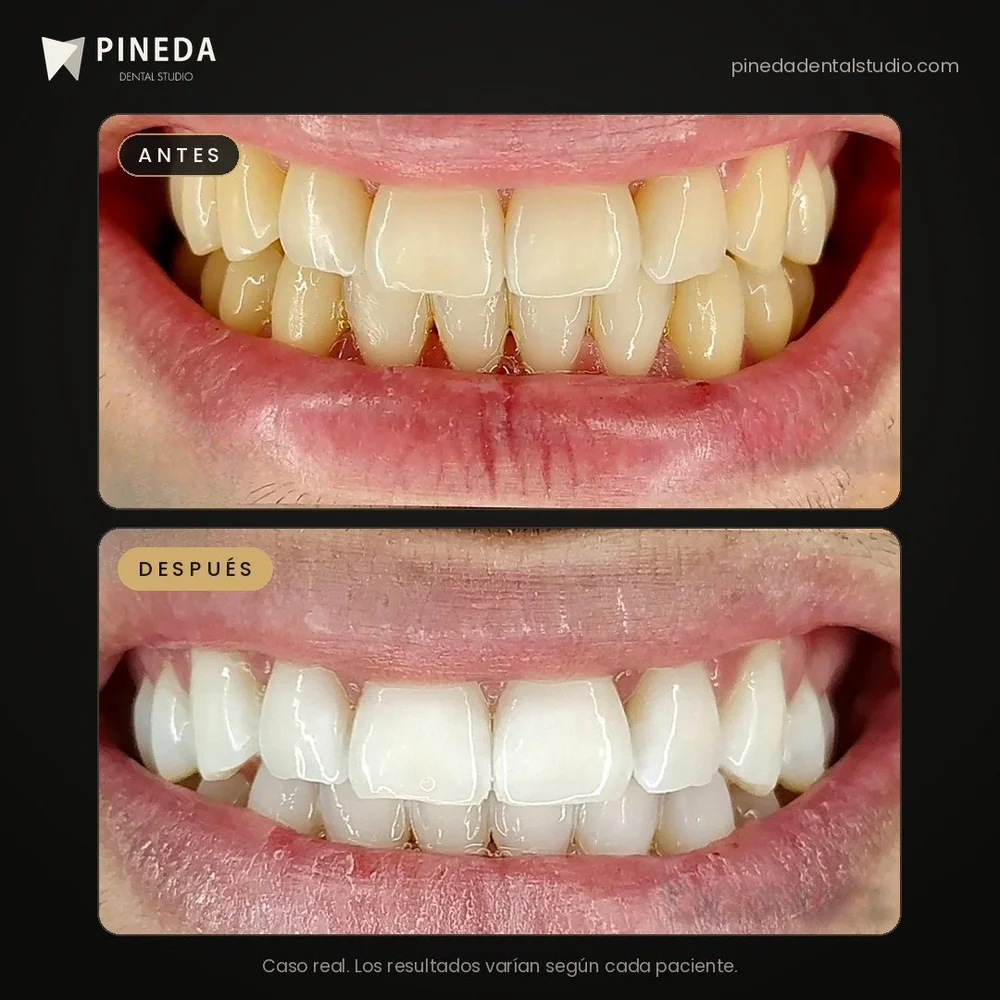
Teeth with a marked yellowish shade across the whole smile. After diagnosis and a professional cleaning, in-office whitening with sensitivity control: the color ended up several shades lighter and even.
Real case treated at our clinic in Recoleta, with the patient's consent. Results vary from person to person.
Is it better in the office or at home with trays from the dentist?
There's a naming mix-up worth clearing up here: “at home” is not the same as “homemade.” At-home whitening, with trays custom-made for your mouth and a gel of lower concentration than in-office gel, prescribed and supervised by a dentist, is professional whitening done at home.
And it works. A systematic review of 12 clinical trials found no difference between supervised at-home whitening and in-office whitening, either in the result or in the risk or intensity of sensitivity. The authors ask for caution, because the protocols compared were very different from one another (de Geus et al., 2016).
The real difference is timing: in-office concentrates the treatment into a few appointments, and at-home spreads it over days or weeks of daily use. For the teeth whitening we do in Recoleta we work with three protocols: diode laser in two sessions, LED in three sessions, and a combination of two LED sessions plus custom trays with gel to boost the result at home. All three start the same way: diagnosis, shade recording and a professional cleaning.
At the clinic · Pineda Dental Studio
What a whitening session looks like

First the gums and lips are protected. Then the clinical gel is applied and activated according to the chosen protocol. Before all that, there was a diagnosis, a shade recording and a professional cleaning.
Recorded at our clinic in Recoleta, with the patient's consent.
How do I know what I need?
Before choosing a method, it helps to know what kind of color you're dealing with. This guide doesn't replace a diagnosis, but it helps you sort things out:
- Coffee, mate or tobacco stains on a color you like. You don't need whitening: you need a professional cleaning. We explain it in our article on air polishing.
- Clean teeth, but yellow. The color comes from inside: this is what peroxide whitening is for.
- A single grey or dark tooth. It's not a stain: it's often a nerve that has died. It gets assessed and, if appropriate, lightened from the inside.
- White spots. Whitening doesn't remove them and they may still show. They're treated with resin infiltration.
- Fillings, veneers or crowns on your front teeth. They won't change color. You whiten first and replace them afterwards, or plan everything together with veneers.
- Sensitivity, receding gums or worn teeth. First we look for the cause. Whitening on top of that is starting at the end.
Frequently asked questions
How can I whiten my teeth at home without damaging them?
The only approach with evidence behind it is the supervised one: custom-made trays and a gel prescribed by a dentist, after a diagnosis. What you can safely do on your own, like brushing with fluoride toothpaste and rinsing with water after mate or coffee, cleans and maintains, but doesn't change the color.
Does baking soda damage enamel?
On its own, it's a mild abrasive, softer than enamel. The problem is mixing it with lemon or vinegar, scrubbing hard or using it instead of fluoride toothpaste. And it doesn't whiten: it cleans surface stains.
Does lemon with baking soda whiten teeth?
No. Lemon juice is an acid, with a pH of 2.25, that softens enamel, and lost enamel doesn't come back. In the lab, a similar recipe of acidic fruit with baking soda whitened no more than water and reduced enamel hardness.
Does activated charcoal whiten teeth?
There's no evidence that it does or that it's safe. It doesn't change the tooth's internal color, its abrasiveness isn't controlled and most products contain no fluoride.
Do whitening strips work?
The ones with peroxide do whiten, but they aren't recommended without professional supervision. A cleaning is essential before any whitening: if the tooth surface is dirty or has tartar, the gel has no effect. Also, using them without a prior check-up can backfire, because you don't know whether there are cavities, inflamed gums or another condition that rules out whitening. And they don't work on fillings, veneers or crowns.
Does hydrogen peroxide solution work to whiten teeth?
It's not a good idea. It has the same active ingredient as the gels, but as a liquid it doesn't stay on the tooth, it irritates soft tissues and it gets swallowed. The US poison control center advises against using it as a whitener.
Can a composite filling, a veneer or a crown be whitened?
No. Peroxide only works on natural teeth. If the surrounding teeth get lighter, the restoration looks darker and needs to be replaced to match the shade.
The fear was pointed in the wrong direction
Whitening doesn't ruin enamel. Acid, wear and persistence do, which is exactly what many home recipes call for. What whitening does have is possible temporary discomfort, clear limits and one requirement: that someone looks at your mouth first.
If you'd like lighter teeth and don't know where to start, at our dental clinic in Recoleta, Buenos Aires, we start with the diagnosis: what kind of color you have, which method suits it and what result is reasonable to expect. It's the same conversation any dentist should offer you before whitening.
Ayacucho 1230, Recoleta · We reply the same day
📍 We look forward to seeing you at our clinic in Recoleta, Buenos Aires.
👩🏻⚕️ About the author and clinical director
Od. Mariana Pineda (M.N. 39.080) is a dentist (José Antonio Páez University, 2014) and trained in fixed, removable and implant-supported prosthodontics at the Argentine Dental Association (2018). As clinical director of Pineda Dental Studio, she leads a multidisciplinary team of more than 10 dentists in maxillofacial surgery, implants, oral rehabilitation, cosmetic dentistry and endodontics, following international protocols for minimally invasive dentistry.
Medical notice: the information in this article is for educational purposes. Whether whitening is indicated, and the method and protocol, depend on the individual clinical diagnosis we make at the clinic. The lab studies cited show trends and don't replace the assessment of each case.
📚 Scientific sources consulted
- Eachempati, P., Kumbargere Nagraj, S., Kiran Kumar Krishanappa, S., Gupta, P., & Yaylali, I. E. (2018). Home-based chemically-induced whitening (bleaching) of teeth in adults. Cochrane Database of Systematic Reviews, 2018(12), CD006202.
- Kwon, S. R., Meharry, M., Oyoyo, U., & Li, Y. (2015a). Efficacy of do-it-yourself whitening as compared to conventional tooth whitening modalities: an in vitro study. Operative Dentistry, 40(1), E21–E27.
- Kwon, S. R., et al. (2015b). Effect of various tooth whitening modalities on microhardness, surface roughness and surface morphology of the enamel. Odontology, 103(3), 274–279.
- de Geus, J. L., Wambier, L. M., Kossatz, S., Loguercio, A. D., & Reis, A. (2016). At-home vs in-office bleaching: a systematic review and meta-analysis. Operative Dentistry, 41(4), 341–356.
- Zanolla, J., Marques, A. B. C., da Costa, D. C., de Souza, A. S., & Coutinho, M. (2017). Influence of tooth bleaching on dental enamel microhardness: a systematic review and meta-analysis. Australian Dental Journal, 62(3). doi:10.1111/adj.12494
- Hara, A. T., & Turssi, C. P. (2017). Baking soda as an abrasive in toothpastes: mechanism of action and safety and effectiveness considerations. Journal of the American Dental Association, 148(11S), S27–S33.
- Reddy, A., Norris, D. F., Momeni, S. S., Waldo, B., & Ruby, J. D. (2016). The pH of beverages in the United States. Journal of the American Dental Association. doi:10.1016/j.adaj.2015.10.019
- Brooks, J. K., Bashirelahi, N., & Reynolds, M. A. (2017). Charcoal and charcoal-based dentifrices: a literature review. Journal of the American Dental Association, 148(9). doi:10.1016/j.adaj.2017.05.001
- Greenwall, L. H., Greenwall-Cohen, J., & Wilson, N. H. F. (2019). Charcoal-containing dentifrices. British Dental Journal, 226(9), 697–700.
- Vaz, V. T. P., Jubilato, D. P., Oliveira, M. R. M., Bortolatto, J. F., Floros, M. C., Dantas, A. A. R., & Oliveira Junior, O. B. (2019). Whitening toothpaste containing activated charcoal, blue covarine, hydrogen peroxide or microbeads: which one is the most effective? Journal of Applied Oral Science, 27, e20180051.
- American Dental Association. Whitening (Oral Health Topics, updated November 11, 2026) and Natural teeth whitening (MouthHealthy).
- ANMAT. Disposición 5661/2025. Boletín Oficial de la República Argentina, August 6, 2025.
- Council of the European Union. Directive 2011/84/EU of 20 September 2011 on hydrogen peroxide in oral products and tooth whitening products.
- National Capital Poison Center. Hydrogen peroxide (poison.org).
