
It's almost always just one. An incisor that, at some point, started to look different from the one next to it: first a little duller, then grey, in some cases almost black. Often there's a blow behind it (a soccer game at twelve, a bike fall, hitting the edge of a pool) that didn't seem serious at the time. Other times there was a root canal and the tooth changed color afterwards. And some people don't remember anything: one day they saw it in a photo and there it was.
What almost all of them have in common is that they tried something that didn't work. Whitening toothpastes, strips, an in-office whitening that lightened every tooth except that one. And the wrong conclusion they reach is that "that tooth can't be fixed".
It can. In most cases, the right treatment isn't the one they tried. Here we explain why a tooth darkens from the inside, why conventional whitening can't reach it, what the internal whitening we do at Pineda Dental Studio is like, and when the solution is a veneer or a crown.
In short
A single tooth that turns grey or black almost always has a dead pulp (pulp necrosis), usually from an old blow. Remnants of blood and tissue break down inside the tooth and stain the dentin from within, which is why no external whitening can reach it. Treatment has two parts: first root canal treatment, which resolves the infection, and then internal whitening, which places the whitening agent inside the tooth, where the pigment is. The evidence shows an average improvement of about six shades and 85% stability at 25 years in the longest published series, although some cases need a touch-up over time. When the darkening is very deep or the tooth has lost structure, the solution is a veneer or a crown. What decides which is right is the diagnosis, not the catalog.
Why does a tooth turn grey or black?
Inside every tooth there's living tissue, the pulp, with blood vessels and nerves. When a blow cuts off the blood supply (even if the tooth doesn't break or move), the pulp can die silently. Sometimes it hurts for a few days; often it never hurts at all.
What happens next is chemistry. The red blood cells left inside the tooth break down and release iron. That iron combines with sulfur compounds produced by the breakdown of the tissue and forms iron sulfide, a black compound that seeps into the dentin tubules: millions of microscopic channels running from the center of the tooth toward the enamel (Coelho et al., 2020). Enamel is translucent, so what you see from the outside is that dark pigment, seen through a window.
That's why the typical color is grey, bluish or dark brown, and why it affects a single tooth. Stains that affect the whole mouth (from coffee, mate, tobacco or tetracyclines in childhood) have a different origin and a different treatment; we cover those in the article on teeth whitening.
There's a second, less well-known cause: a tooth that darkens after root canal treatment. When remnants of pulp tissue are left in the chamber, or when the sealing material reaches too high, into the crown, the tooth can gradually take on a grey tone over the years. It's one of the reasons why, when we do a root canal, we clean the chamber so carefully and keep the sealing material below the gum line.
Is a dark tooth always dead?
Almost always, but it's not something you can decide by looking. Some teeth darken temporarily after a blow and get their color back when the pulp recovers; and some teeth with a dead pulp haven't changed color yet.
What we do at the clinic is confirm it: vitality tests (cold, electrical stimulus), percussion, and an X-ray to see whether there's a lesion in the bone around the root, which is the sign that the infection has already spread outside the tooth. That last point matters more than it seems: a tooth with necrosis isn't just a cosmetic problem. It's a reservoir of bacteria that sooner or later causes an abscess. That's why the first step of treatment is never cosmetic.
Why doesn't regular whitening work on this tooth?
Because it works from the wrong side. Conventional whitening (in-office or with trays) applies the gel to the outer surface of the tooth and lightens the enamel and the outer dentin. It works very well for yellowing from coffee or age, which sits in the outer layers.
The pigment in a tooth with necrosis is in the center and deep in the dentin. Gel applied from the outside arrives weakened, the tooth lightens a little (or not at all) and the difference with its neighbors, which do respond, becomes more obvious. It's the typical case of someone who had whitening and came out with the grey tooth even more noticeable.
What is internal whitening and how do we do it?
It's the technique that places the whitening agent inside the tooth, in the chamber where the pulp was, millimeters from the pigment. It has been used for decades (the original technique was described in 1961) and it has one essential condition: the tooth must have a proper root canal treatment first.
- Root canal treatment, or checking the existing oneIf the tooth doesn't have a root canal, it's done first: it resolves the infection and leaves the inside clean. If it already has one, we check on the X-ray that it's well sealed; if not, it's redone. Whitening a tooth with a deficient root canal is whitening over an unresolved problem. Our rotary endodontics with laser is the usual first step.
- Cleaning the chamberAccess is opened through the inner surface of the tooth and any remnants of tissue, sealing material or old restoration contributing color are removed.
- Cervical barrierThe canal filling is removed a few millimeters below the gum line and a protective seal is placed. It's the step that protects the root, and it's never skipped. We explain why below.
- Placing the whitening agentIn the walking bleach technique, the gel is sealed inside the chamber and you go home with it working. It's renewed every few days, usually over two to four short appointments, until it matches the shade of the neighboring teeth. When the case calls for it, we also add an in-office session with activation to speed up or boost the result.
- Color check and stabilizationWhen the shade matches, the agent is removed, neutralized and the tooth is left to rehydrate for a few days. During that period the color may adjust slightly: that's why it isn't restored the same day.
- Permanent restoration of the accessThe opening we worked through is closed with composite in the final shade. If the tooth also has an old restoration on the visible surface, this is the time to renew it so it matches the new shade.
Internal whitening · What the evidence says
Three numbers to keep in mind
It works, and well. And some cases need a touch-up over the years. Both things are true at once.
Meta-analysis of 300 patients: 6.27 shade guide units (95% CI 5.36–7.17) (Frank et al., 2022).
Series of 40 patients with yearly check-ups over 25 years, with 10% carbamide peroxide (Amato et al., 2018).
Studies report partial relapse in 10% at 2 years, rising over time (Coelho et al., 2020).
The touch-up is simple: a short cycle of gel inside the chamber. What isn't advisable is repeating it without supervision or using high concentrations to "save time".
Real case · Pineda Dental Studio
LED whitening in three sessions plus internal whitening
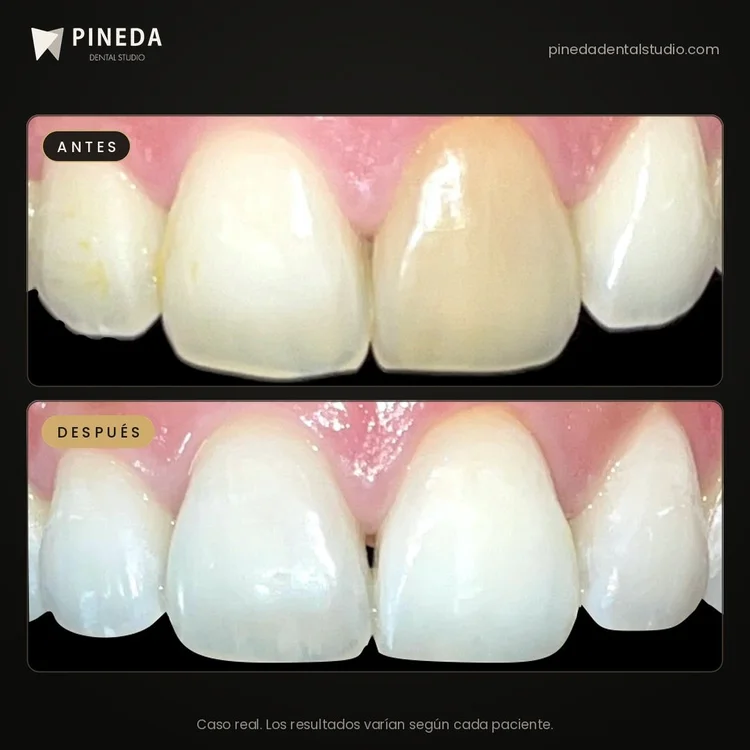
A central incisor with a yellowish-brown tone that set it apart from the neighboring tooth. We combined internal whitening of that tooth with three sessions of LED whitening for the smile, and the color evened out.
A real case treated at our Recoleta clinic. Results vary from person to person.
Are there risks?
One, and it's worth naming clearly because it's what justifies the protocol. It's called external cervical resorption: a lesion on the root, at the neck of the tooth, that appears when the whitening agent leaks through the dentin tubules to the ligament around the root and irritates it. It's uncommon, it can appear years later and, if it isn't detected, it can cost the tooth.
The classic analysis of predisposing factors, covering 257 teeth with this lesion, found that internal whitening was among the associated factors, along with orthodontics and trauma (Heithersay, 1999). And the systematic review of techniques identified what the risk is associated with: techniques that use heat, hydrogen peroxide concentrations above 30% and prolonged exposure; and it described the cervical barrier as the standard of care precisely to prevent it (Coelho et al., 2020).
That's why our protocol has three fixed rules: always a cervical barrier, controlled concentrations, and regular X-ray check-ups after treatment to detect any change in the root while it can still be treated. A quick internal whitening, without a barrier and with the strongest gel available, is cheaper to do and more expensive to pay for.
What if whitening isn't enough?
Sometimes it isn't, and it's better to know beforehand. Very old, very deep or brown discoloration responds less. And some teeth, besides being dark, have lost structure: a fracture, a large restoration, a wide root canal opening. For those cases the path is restorative.
Dark tooth · Pineda Dental Studio
The options, from least to most invasive
We always start with the one that preserves the most tooth. We only move down the list when the previous option doesn't solve the case.
| Option | How much tooth is touched | For which case | What the evidence shows | Keep in mind |
|---|---|---|---|---|
| Internal whiteningFirst choice Gel inside the chamber, after the root canal. | No enamel | A tooth with a root canal, preserved structure and grey or yellowish darkening. | Improvement of ~6 shades; 85% stable at 25 years in the longest series. | May need a touch-up. Requires a cervical barrier and check-ups. Doesn't work if the root canal was done poorly. |
| Masking composite Opaque resin on the visible surface. | Minimal | Mild darkening that whitening didn't fully even out, or an old restoration that needs renewing. | A direct, repairable and reversible solution. | Shorter lifespan and less shine than ceramic; may stain over the years. |
| Composite or ceromer veneer An indirect layer on the visible surface. | Little | Moderate darkening; when the goal is to cover it with less preparation and lower cost than porcelain. | Good masking with the right thickness; more repairable than ceramic. | Less long-term color stability and shine than porcelain. |
| Porcelain veneer A ceramic layer bonded to the enamel. | Little to moderateA bit more preparation on dark teeth, to give the masking enough thickness. | Deep darkening that didn't respond to whitening; when shape or position also need correcting. | 89% survival with a median follow-up of 9 years (Morimoto et al., 2016). | Irreversible. On very dark teeth it's combined with whitening beforehand so the ceramic doesn't have to be as opaque. |
| Crown Covers the whole tooth. | The whole outline | A dark tooth that has also lost a lot of structure: fracture, large restoration, wide opening. | It's the factor that most improves the survival of a tooth with a root canal when little structure is left (Ng et al., 2010). | The most invasive. It's indicated for lost structure, not for color: color alone is solved with less. |
Often the answer is a combination. Internal whitening to lift the base shade and then a thin veneer, or composite, for the details. The lighter the tooth is beforehand, the less what goes on top has to mask, and the less tooth needs to be touched.
The indication is decided at the visit with an X-ray, vitality tests and an assessment of the remaining structure.
Real case · Pineda Dental Studio
Another case: an incisor that had turned grey
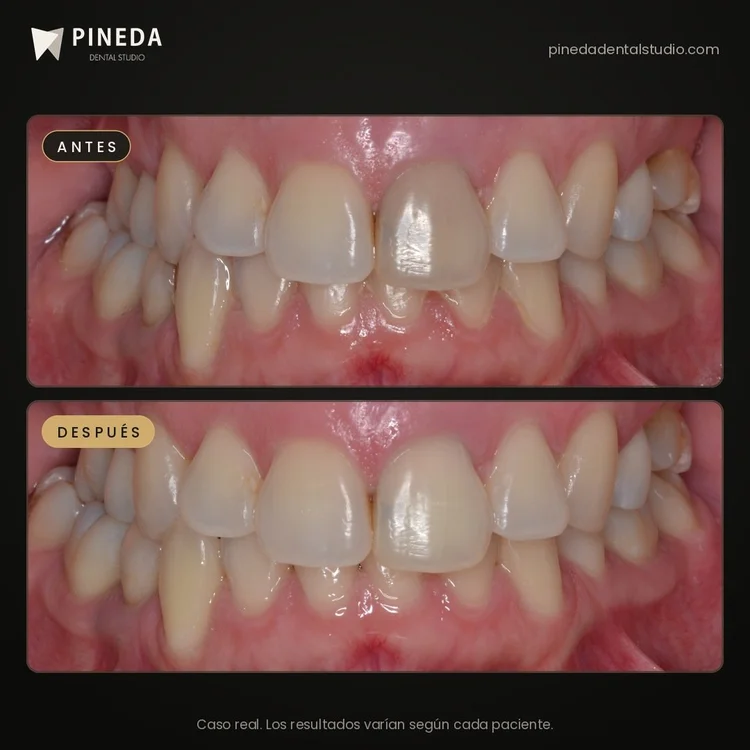
A central incisor with a grey tone that set it apart from the neighboring teeth. With internal whitening, the color ended up much closer to the rest of the smile, without touching the enamel.
A real case treated at our Recoleta clinic. Results vary from person to person.
How do we choose in each case?
- The state of the root canal. That comes first. Without a proper root canal there's no internal whitening, and a veneer on an infected tooth won't last either.
- The degree and type of darkening. Grey or yellowish, recent, in a tooth with intact enamel: an ideal candidate for whitening. Dark brown, decades old, with cracked enamel: it will probably need covering.
- How much structure is left. A whole tooth is whitened. A tooth with a large restoration or a fracture also needs protection: that's where veneers and crowns come in, which we plan with our restorative dentistry area.
- What you expect from the result. Whitening matches the shade to the neighboring teeth; it doesn't change shape or position. If you also want to correct that, it's a different conversation, and we have it in our cosmetic dentistry and smile design area; we wrote about timelines for veneers and crowns in this article.
- Age. In teenagers and young adults we prefer to exhaust whitening before any irreversible option: a veneer placed at 18 will be replaced several times in a lifetime.
And one rule we keep even if it's less profitable: if the color can be solved with whitening, we don't recommend a veneer for color. Invasive treatment is reserved for what needs it.
Real case · Pineda Dental Studio
Blanqueamiento interno y blanqueamiento de toda la sonrisa
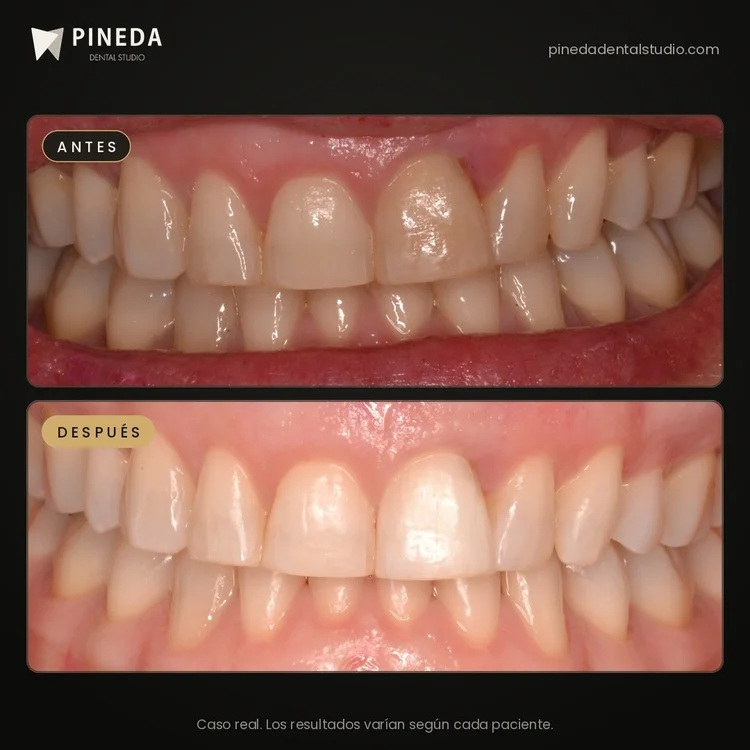
A central incisor darker than the others, in a smile that also looked yellowish. We combined internal whitening of that tooth with whitening of the rest: the incisor ended up matching its neighbors and the whole smile looked lighter.
A real case treated at our Recoleta clinic. Results vary from person to person.
How long does the result last?
Years, in most cases, with a known tendency: some teeth darken slightly again over time. The systematic review of techniques reports partial relapse in about 10% of cases at two years, a figure that grows over longer periods (Coelho et al., 2020). At the same time, the series with the longest published follow-up (40 patients checked every year for 25 years) found stable color in 85% (Amato et al., 2018).
What we do with those two facts is simple: we tell you before starting, we schedule check-ups, and if at some point the shade drops, a short touch-up cycle brings it back. What we don't do is promise it won't happen.
Frequently asked questions
Why did a tooth turn black if it doesn't hurt?
Because the pulp can die without any symptoms, especially after an old blow. Remnants of blood and tissue break down inside the tooth and stain the dentin from within. The fact that it doesn't hurt doesn't mean there's no infection: it needs to be confirmed with vitality tests and an X-ray.
Can a dead tooth be whitened?
Yes, with internal whitening, after doing or checking the root canal treatment. The gel is placed inside the tooth, where the pigment is. Conventional whitening, from the outside, can't reach it.
Do I need a root canal if the tooth doesn't bother me?
Yes. A tooth with necrosis is a source of bacteria that sooner or later causes an abscess, and it's also the condition for being able to whiten it from the inside. The root canal isn't a cosmetic step: it's what solves the underlying problem.
How many appointments does internal whitening take?
Usually two to four short appointments to renew the gel, plus the root canal if the tooth didn't have one and a final appointment to close the access. Only a few days pass between them.
Can it darken again?
It can, slightly, in some cases and over the years. It's fixed with a short touch-up cycle. That's why we do check-ups.
Does internal whitening weaken the tooth?
No, when it's done with a cervical barrier, controlled concentrations and no heat. The known risk (cervical resorption) is associated with aggressive techniques and the lack of a barrier, and it's monitored with follow-up X-rays.
Is it better to go straight to a veneer?
If the color can be solved with whitening, no: a veneer is irreversible and requires preparing the tooth. We recommend it when the darkening doesn't respond or when the tooth has also lost structure or needs a change of shape.
What if the dark tooth already has an old crown?
What looks grey is usually the gum or the edge, because the dark tooth underneath shows through. We assess whether it's better to whiten what's left of the tooth before making the new crown, or to switch to a type of crown that masks it better.
A dark tooth isn't a lost tooth
It's a tooth asking for two things: for the infection inside it to be resolved, and for its color to be restored from the right place. In most cases that's done without touching the enamel. In the rest, there are options that cover and protect it. The only thing that isn't worth it is to keep trying external whitening that doesn't reach it, or to get used to smiling sideways.
Ayacucho 1230, Recoleta · We reply the same day
📍 We look forward to seeing you at our clinic in Recoleta, Buenos Aires.
👩🏻⚕️ About the author and clinical director
Od. Mariana Pineda (M.N. 39.080) is a dentist (José Antonio Páez University, 2014) and trained in fixed, removable and implant-supported prosthodontics at the Asociación Odontológica Argentina (2018). As clinical director of Pineda Dental Studio, she leads a multidisciplinary team of more than 10 dentists in cosmetic dentistry, endodontics, oral rehabilitation, implants and maxillofacial surgery, following international protocols for minimally invasive dentistry.
Medical notice: the information in this article is for educational purposes. Whether internal whitening, prior root canal treatment and restorative alternatives are indicated depends on the individual clinical and X-ray diagnosis we make at the clinic.
📚 Scientific sources consulted
- Coelho, A. S., Garrido, L., Mota, M., Marto, C. M., Amaro, I., Carrilho, E., & Paula, A. (2020). Non-vital tooth bleaching techniques: a systematic review. Coatings, 10(1), 61.
- Frank, A. C., Kanzow, P., Rödig, T., & Wiegand, A. (2022). Comparison of the bleaching efficacy of different agents used for internal bleaching: a systematic review and meta-analysis. Journal of Endodontics. doi:10.1016/j.joen.2021.10.011
- Amato, A., Caggiano, M., Pantaleo, G., & Amato, M. (2018). In-office and walking bleach dental treatments on endodontically-treated teeth: 25 years follow-up. Minerva Stomatologica, 67(6), 225–230.
- Heithersay, G. S. (1999). Invasive cervical resorption: an analysis of potential predisposing factors. Quintessence International, 30, 83–95.
- Morimoto, S., Albanesi, R. B., Sesma, N., Agra, C. M., & Braga, M. M. (2016). Main clinical outcomes of feldspathic porcelain and glass-ceramic laminate veneers: a systematic review and meta-analysis of survival and complication rates. The International Journal of Prosthodontics, 29(1), 38–49.
- Ng, Y.-L., Mann, V., & Gulabivala, K. (2010). Tooth survival following non-surgical root canal treatment: a systematic review of the literature. International Endodontic Journal, 43(3), 171–189.
