
By: Od. Mariana Pineda | Reading time: 7 minutes
Opening a photo from five years ago and noticing your smile had a different glow. Looking in the mirror after your morning mate and seeing dull teeth. Smiling with your lips a little more closed than you'd like.
Teeth whitening is today the most requested cosmetic treatment in the world and, at the same time, the most misunderstood. Between online kits, activated charcoal, "whitening" offered at beauty salons with no dentist and promises of an impossible white, information spreads faster than clinical judgment.
And at the center of that confusion is a basic misunderstanding that almost nobody talks about: enamel isn't white. It's semi-translucent. The color you see in the mirror comes from the layer underneath. That's why some patients brush flawlessly, don't drink coffee or smoke, and still see their smile lose its glow: the problem isn't on the surface, and no toothbrush reaches where it is.
At Pineda Dental Studio we approach whitening from minimally invasive dentistry: before lightening a single shade, we understand why that tooth darkened. Because not all stains are the same, and a misdiagnosed stain is whitening that won't work.
Below we explain, with evidence, what's happening inside your teeth, whether whitening really damages enamel, which of our three protocols suits each case and what to do to make the result last.
IN SHORT
Teeth darken in two ways: external stains deposited on the enamel (mate, coffee, wine, tea, tobacco) and internal changes in the dentin that come with age. Professional whitening works with peroxide, which releases oxygen and breaks up pigment molecules: it doesn't wear, file or thin the enamel. The difference between the protocols (laser, combined and LED) lies in the number of sessions, how sensitivity is managed and how long the result lasts. The diode laser also adds a photobiomodulation effect backed by the literature: it reduces post-treatment sensitivity without compromising whitening.
Why do teeth darken?
The dental literature classifies tooth discoloration into two large groups, and the difference between them is what determines whether whitening will work or not (Watts & Addy, British Dental Journal, 2001).
1. Extrinsic discoloration: what's deposited on the enamel
A thin film of salivary proteins is constantly forming on the tooth surface. Chromogens (the colored molecules in food and drinks) stick to that film and, over time, penetrate the outermost layers of the enamel.
The main culprits in our population:
Mate. It's the great underestimated one. Yerba mate contains tannins in concentrations comparable to or higher than black tea, and Argentine consumption isn't one cup: it's an infusion sipped for hours, constantly refilled. In terms of staining, drinking mate all morning is like giving your enamel a prolonged tannin bath.
Coffee, tea, red wine and cola drinks.
Tobacco (nicotine and tar cause the most stubborn stains, the hardest to remove).
Certain chlorhexidine mouthwashes and iron supplements.
2. Intrinsic discoloration: what happens inside the tooth
This is the factor most patients don't know about. The color you see isn't the enamel's: enamel is semi-translucent. The real color comes from the dentin, the layer underneath.
Over the years, two things happen at once: the enamel thins and becomes more translucent, while the dentin lays down new layers and gradually turns yellower. The result is that the tooth looks darker without any surface stain.
On top of that there are intrinsic causes with specific origins: tetracyclines while teeth are forming, fluorosis, trauma with internal bleeding and pulp necrosis.
Why this distinction defines the treatment
Purely extrinsic, recent discoloration can be solved with a professional cleaning: it doesn't need whitening. Intrinsic discoloration can't be removed with any cleaning, however deep, because the pigment is inside the tissue: that's when whitening is indicated. And some cases (severe fluorosis, banded tetracycline stains) respond only partially and call for considering microabrasion or veneers.
That's why the first step of our protocol is never the gel. It's the diagnosis.
Does teeth whitening damage enamel?
It's the question we get most often at the clinic, and the short answer is no, as long as the treatment is prescribed and supervised by a dentist.
How it really works
Professional gels contain hydrogen peroxide or carbamide peroxide. When applied, the peroxide breaks down and releases oxygen, which diffuses through the enamel prisms to the dentin. There it breaks the double bonds of the chromogen molecules and fragments them into smaller, colorless molecules (Joiner, Journal of Dentistry, 2006).
It's a chemical oxidation process, not a mechanical one. There's no wear, no filing and no loss of tooth structure. The tooth isn't left thinner or weaker: what's destroyed are the molecules that gave it color.
What the evidence says
The largest Cochrane systematic review on the subject analyzed 71 randomized clinical trials with 3,780 adults and concluded that whitening agents effectively lighten teeth compared with placebo. The side effects reported (tooth sensitivity and gum irritation) were mild and temporary, and more frequent the higher the concentration of the agent (Eachempati et al., Cochrane Database of Systematic Reviews, 2018).
The American Dental Association (ADA) takes the same line: whitening is considered safe when done by a licensed professional, and it warns that the real risk comes from excessive or aggressive use without supervision.
What can damage your enamel
This is the uncomfortable part, and the one that really matters:
Activated charcoal, baking soda and lemon. Charcoal is an abrasive with no evidence that it whitens or that it's safe. Baking soda on its own is a mild abrasive: it cleans stains but doesn't change the color (we explain it in home vs. professional teeth whitening). Lemon is an acid that erodes enamel. Enamel doesn't regenerate: that damage is permanent. Paradoxically, by thinning it, they reveal more dentin and the tooth ends up yellower.
Kits bought online. Unverified concentration, no gum isolation, no prior diagnosis and no idea what's underneath.
"Whitening" at beauty salons with no dentist. Applying peroxide to a mouth without a diagnosis is a procedure with risks, not a beauty service.
Whitening over active disease. Untreated cavities, leaking fillings, enamel cracks or gum recession turn a comfortable procedure into a painful one, and in some cases make the existing lesion worse.
Repeating it too often, without intervals or professional supervision.
Why the cleaning beforehand isn't an extra
In all three protocols we offer, a professional teeth cleaning is included before whitening. It's not a sales courtesy: the gel doesn't get through plaque or tartar. Whitening a tooth that hasn't been cleaned produces uneven results, with areas that respond and areas that don't. The preparation is part of the result.
Why does sensitivity appear and how is it controlled?
The same oxygen that breaks up pigments passes through the dentinal tubules and causes a temporary, reversible inflammatory response in the pulp. That's post-whitening sensitivity: it's not damage, it's an expected reaction that goes away on its own.
What determines its intensity isn't the technology, but specific clinical variables: the concentration of the gel, the total contact time with the tooth, the number and spacing of sessions, the presence of gum recession or exposed roots, and the prior condition of the enamel (enamel already eroded by reflux, acidic drinks or aggressive brushing is much more reactive).
In our protocol, sensitivity is managed before we even start: diagnosis of the enamel and any recession, careful isolation of gums and lips, use of desensitizing agents and individual adjustment of concentrations and exposure times. When it does appear, it usually resolves within 24 to 48 hours.
Not all "lights" do the same thing: what the diode laser really adds
There's a very widespread confusion here, even within the profession: people talk about "light whitening" as if all technologies were equivalent. They aren't, and the difference is precisely what explains how comfortable the treatment is.
LED lamps give energy to the gel to speed up the release of oxygen. At the clinic they're used within a protocol with the concentration, timing and number of sessions set for each patient, with the gums protected and sensitivity controlled.
The diode laser works on a different principle. Besides speeding up the gel's activation and making it highly precise (which allows shorter cycles and less total contact time with the tooth), laser energy in the infrared spectrum produces an effect known as photobiomodulation: it acts on the pulp tissue, modulating the inflammatory response and raising the pain threshold. In other words, it doesn't just speed up the process: it actively acts on the mechanism that causes sensitivity.
And this is documented. A systematic review with meta-analysis of placebo-controlled clinical trials found that photobiomodulation significantly reduced post-whitening sensitivity in every session evaluated and, crucially, without affecting the whitening result (Silva et al., Photobiomodulation, Photomedicine, and Laser Surgery, 2022).
That's the specific clinical reason the diode laser is our preferred choice for patients with a history of tooth sensitivity: it's not that it whitens "more", but that it reaches the same result with a much better comfort profile, in just two sessions.
That said, it's worth keeping the order of importance clear: the agent that whitens is the peroxide gel. The technology defines the structure of the treatment (how many sessions, how much contact time, how sensitivity is managed) but never replaces the prior diagnosis. Excellent equipment used without assessing the enamel is still a bad treatment.
Which of the three protocols is yours?
Pineda Dental Studio · Recoleta
The three whitening protocols, compared
No whitening is better than another: there's the one that suits your type of stain, your enamel and the time you have. This table sums up the real differences between the three protocols we offer.
| Protocol | Technology | Visits | At-home boost | Sensitivity risk | Recommended if… |
|---|---|---|---|---|---|
| Laser WhiteningPremium Maximum efficiency and comfort, with short activation cycles. | Diode laser | 2 visits | Not needed | MinimalShort activation + photobiomodulation. | You want intense whitening with minimal sensitivity, or you have a history of tooth sensitivity. |
| Combined Whitening The deepest, longest-lasting whitening. | Clinical LED light + at-home gel | 2 visits | Yes: custom trays + gel kit | LowMeasured boost gel. | You want the deepest result and the option to top it up at home over time. |
| Blanqueamiento LED Aclaramiento progresivo y supervisado. | Clinical LED light | 3 sessions | Not needed | MediumControlled session by session. | You want to fade stains and progress gradually, with professional control at every stage. |
All three protocols share the same clinical foundation: prior enamel diagnosis and shade recording + professional teeth cleaning. That preparation isn't an extra: it's what helps achieve even whitening with no surprises.
The final choice is made at the visit, based on each patient's type of discoloration, enamel condition and existing restorations. See the protocols in detail.
Diode laser whitening (Premium)
Our most efficient option and the one with the best comfort profile. The diode laser allows very short, highly precise activation cycles, which reduces the time the gel stays on the tooth in each application. Treatment is completed in two sessions for more intense, even whitening. On top of that comes the photobiomodulation effect described above, which acts directly on the pulp response and reduces sensitivity afterwards without compromising the whitening. It's the natural choice if you want the best result with minimal discomfort, or if you have a history of tooth sensitivity and had ruled out whitening until now.
Combined whitening (Longest-lasting)
The gold standard when the goal is the deepest, most stable result. It combines two in-office LED sessions with a kit of custom-made trays and boost gel for supervised home use. The clinical logic is sound: the in-office power produces the initial jump in shade, and the at-home boost, at low, controlled concentrations, consolidates and extends that result. It's also the only protocol that gives you a tool to maintain the color over time.
LED whitening (Progressive in-office)
Gradual whitening in three in-office LED activation sessions. By splitting the treatment, each session works with a lower load and we can assess how the enamel responds before moving on to the next. It's the right option when the goal is to fade stains progressively, with professional control at every stage.
All three share the same foundation: enamel diagnosis, recording the starting shade and a professional teeth cleaning beforehand.
Real case · Pineda Dental Studio
Before and after professional whitening
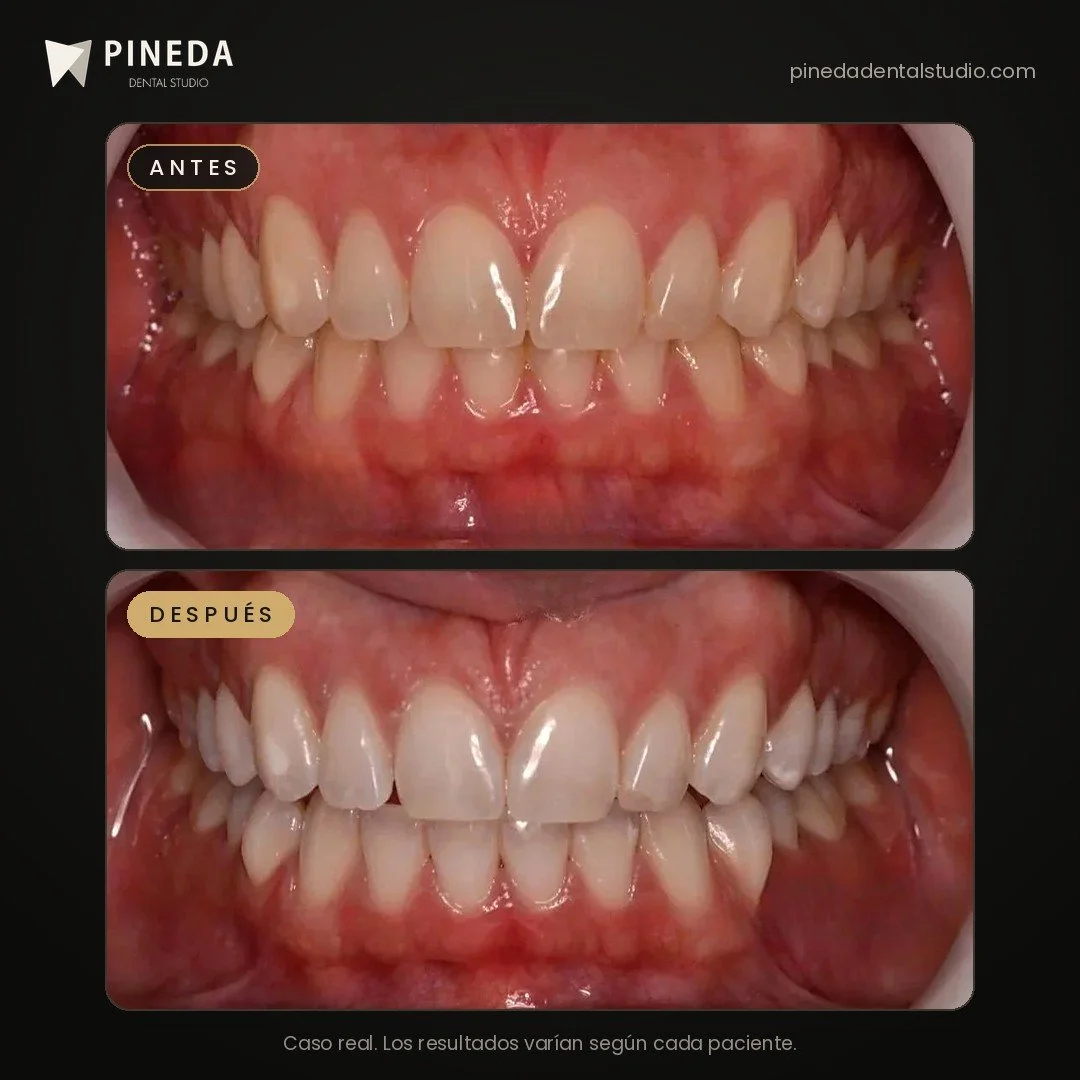
Notice that the change isn't limited to the central incisors: the whitening is even across the whole front of the mouth, including the canines, which are the teeth with the most color saturation and the ones that tend to end up uneven when the protocol isn't supervised.
Clinical photos of a real patient, taken with the same lighting and framing. Results vary depending on the starting shade, the type of discoloration and each patient's habits.
How long does teeth whitening last?
A well-done, well-cared-for professional whitening usually lasts about a year. But that figure is an average, not a promise: how long it really lasts depends almost entirely on your habits afterwards.
The first 48 hours are decisive
Right after treatment, the enamel is temporarily dehydrated and more permeable. That's when pigments penetrate most easily, and it's also when most patients unknowingly undo a good part of the result.
During the first 48 hours, avoid: mate, coffee, tea, red wine, cola drinks, beetroot, tomato sauce, curry, red berries, chocolate and tobacco. The practical rule is simple: if it would stain a white tablecloth, it shouldn't go in your mouth during those 48 hours.
Long-term maintenance
Rinse with water right after mate, coffee or wine. It's the simplest measure and one of the most effective.
Professional teeth cleanings every six months, which remove extrinsic discoloration before it sets in.
Avoid highly abrasive "whitening" toothpastes for daily use: they don't whiten, they wear.
With the combined protocol, top-up sessions with the home kit, following the guidelines we give you.
Suspender o reducir el tabaco. No existe protocolo capaz de sostener un resultado frente al consumo sostenido.
Who isn't a candidate (or needs a different plan)?
Part of working with clinical judgment is saying when whitening isn't appropriate:
Patients with veneers, crowns or composite fillings on the front teeth. Peroxide only works on natural tooth structure: porcelain and composite don't change color. In these cases the right order is to whiten the natural teeth first and then replace the restorations to match the new shade. Doing it the other way around leaves a permanent mismatch.
Active cavities, leaking fillings or untreated gum disease. The disease is treated first.
Marked gum recession, with exposed root surfaces.
Pregnancy and breastfeeding, when treatment is postponed as a precaution.
Very young patients, whose teeth haven't fully erupted or whose enamel hasn't fully matured.
Tetracycline stains or severe fluorosis, where whitening alone gives limited results and alternatives are worth considering.
Unrealistic expectations. There's no single "white". Each person has a maximum tooth color determined by their biology, and the goal of a serious treatment is to reach that natural white, not to imitate a filter.
Frequently asked questions
How many shades can teeth be lightened? It depends on the starting shade and the type of discoloration. Mostly yellow teeth respond better than greyish ones. At the first visit we record the color with a reference shade guide, so we can compare before and after objectively instead of relying on perception.
Can I whiten if I have braces or just finished orthodontics? Not during orthodontic treatment, because brackets prevent even whitening. Once you've finished, it's best to wait a few weeks before whitening.
I have a crown on a front tooth. Will it still work? Whitening won't change that crown. What we do is lighten the natural teeth and then assess replacing the restoration to match the new shade. It's a decision we discuss before we start.
Can I whiten if I already have tooth sensitivity? In most cases yes, with an adapted protocol: lower concentrations, shorter exposure times, desensitizing agents and, preferably, diode laser activation for its photobiomodulating effect on the pulp tissue. The first step is to find the cause of that existing sensitivity, which is often gum recession or acid erosion and needs its own treatment.
What's the real difference between laser and LED whitening? LED light gives energy to the gel to speed up the release of oxygen. The diode laser, besides more precise activation and shorter cycles, produces photobiomodulation: an effect on the pulp tissue that reduces sensitivity afterwards without reducing whitening, according to the systematic review by Silva and colleagues (2022). That's why the laser protocol is completed in two short sessions and is our preferred choice for sensitive patients, while LED works progressively over three sessions.
Does it hurt during the session? No. It isn't a painful procedure. Mild, temporary sensitivity may appear in the hours afterwards, which is managed with the instructions we give you at the end.
What if I go back to drinking mate every day? You can, once the first 48 hours have passed. Just know that the result will last less than for someone who doesn't drink it, and that rinsing with water afterwards and having cleanings every six months make up for much of that difference.
A whiter smile starts with a diagnosis, not a gel
Whitening isn't a product you buy: it's a treatment that's prescribed. The difference between a bright, even, sensitivity-free result and a frustrating experience almost always lies in what happens before the light is switched on: understanding what kind of stain the patient has, what condition their enamel is in and which protocol suits their case.
If you've noticed your smile has lost its brightness, if you've tried over-the-counter products with no result or if you'd like to whiten but you're worried about sensitivity, the first step is a professional assessment.
Ayacucho 1230, Recoleta · We reply the same day
📍 We look forward to seeing you at our clinic in Recoleta, Buenos Aires.
👩🏻⚕️ About the author and clinical director
Od. Mariana Pineda is a dentist (José Antonio Páez University, 2014) and trained in fixed, removable and implant-supported prosthodontics at the Argentine Dental Association (2018). As clinical director of Pineda Dental Studio, she leads a multidisciplinary team of more than 10 dentists in oral rehabilitation, cosmetic dentistry, implants and maxillofacial surgery, following international protocols for minimally invasive dentistry.
Medical notice: the information in this article is for educational purposes. Which whitening protocol is indicated (laser, combined or LED) and whether it's suitable depend on the individual clinical diagnosis we make at the clinic.
📚 Scientific sources consulted
Eachempati, P., Kumbargere Nagraj, S., Kiran Kumar Krishanappa, S., Gupta, P., & Yaylali, I. E. (2018). Home-based chemically-induced whitening (bleaching) of teeth in adults. Cochrane Database of Systematic Reviews, Issue 12, Art. No.: CD006202.
Joiner, A. (2006). The bleaching of teeth: a review of the literature. Journal of Dentistry, 34(7), 412–419.
Watts, A., & Addy, M. (2001). Tooth discolouration and staining: a review of the literature. British Dental Journal, 190(6), 309–316.
Silva, P. G. B., Cetira Filho, E. L., Nigri, F. M. N., Dantas, T. S., Candeiro, G. T. M., & Neri, J. R. (2022). Photobiomodulation reduces pain-related symptoms without interfering in the efficacy of in-office tooth bleaching: a systematic review and meta-analysis of placebo-controlled clinical trials. Photobiomodulation, Photomedicine, and Laser Surgery, 40(3), 163–177.
American Dental Association (ADA). Recommendations on the safety and effectiveness of tooth whitening procedures.
