
There's a moment, at every dental cleaning, when you run your tongue over your teeth and feel the difference. That smooth surface, teeth that feel new, is the goal of every professional cleaning.
What has changed in recent years isn't that goal. It's how we get there.
An air polisher (also called air polishing) is an instrument that cleans the tooth surface by spraying a controlled jet of air, warm water and an ultra-fine powder. It doesn't spin, doesn't vibrate and makes no motor noise. The powder we use most often has 14-micron particles: for scale, a grain of fine sand measures about 100 microns and a human hair is around 70.
At Pineda Dental Studio we've made air polishing a distinct protocol within our professional cleaning. Here we explain exactly what it does, which powder suits each clinical situation and when we recommend it.
In short
An air polisher cleans the tooth surface with a spray of air, warm water and an ultra-fine powder. Its main documented advantage is comfort: a systematic review with meta-analysis of 17 clinical trials found that polishing with glycine powder is significantly less painful than ultrasonic scaling. It achieves clinical results equivalent to conventional instrumentation, with the advantage of adapting to delicate surfaces: implants, cosmetic restorations and braces. We use three different powders (erythritol, glycine and sodium bicarbonate), and the choice depends on what needs to be removed and from where.
What is biofilm and why does it come back every day?
A biological film made up of salivary proteins and organized bacterial communities forms continuously on the surface of the teeth. It's dental biofilm, and it's not a passive deposit: it's a living, attached structure that starts reorganizing within hours of being removed.
That biofilm is the starting point of the two most common problems in the mouth: cavities and gum inflammation. While it's soft, brushing and flossing keep it well under control. Once it mineralizes and turns into calculus (tartar), it needs professional removal.
And it does a third thing: it holds on to pigments. Chromogens from mate, coffee, tea, wine and tobacco attach to that film, which is why stains appear even when your home hygiene is excellent.
The goal of a professional cleaning is to return the tooth surface to a clean, smooth state, because a smooth surface slows down new biofilm formation. The air polisher is one of the tools we use to achieve that.
How exactly does an air polisher work?
The device combines three elements in a single nozzle:
- Air at controlled pressure, which provides the energy.
- Warm water, which carries away the removed material and makes the procedure much more comfortable than cold water.
- An ultra-fine powder, which disrupts the biofilm and lifts off the staining.
The spray comes out in a cone and is applied a few millimeters from the tooth, in constant motion. There's no rotating mechanical contact or ultrasonic vibration: the work is done by the gentle, dispersed impact of millions of microscopic particles.
That feature (working without rigid contact) is what lets it adapt to irregular surfaces. The spray gets into the grooves and fissures of the chewing surfaces, around orthodontic brackets and into the spaces between teeth and around implants, where the anatomy is complex.
At the clinic · Pineda Dental Studio
What an air polishing session looks like
The spray of air, warm water and ultra-fine powder works without rigid contact against the tooth. It's applied a few millimeters from the surface, in constant motion, and the suction removes the material as it goes.
Recorded at our clinic in Recoleta, with the patient's consent.
Are all powders the same?
No, and this is what determines the result. The air polisher is the device; the powder is what defines what can be done and where. We work with three, and the choice is a clinical decision we make based on the diagnosis.
Air polishing · Pineda Dental Studio
The three powders, and when each one is used
The air polisher is the device; the powder defines what can be done and on which surface. The choice is a clinical decision, not a preference.
| Powder | Particle | Abrasiveness | Where it's applied | Typical use |
|---|---|---|---|---|
| ErythritolFinest Developed to act on biofilm. | 14 microns | Very low | Above and below the gum line. Safe on implants, restorations and braces. | Biofilm, periodontal and implant maintenance, front teeth. |
| Glycine Low-abrasive amino acid. | 25 microns | Low | Above and below the gum line. | Biofilm and maintenance. The powder with the best evidence for comfort. |
| Sodium bicarbonate The classic, the most powerful. | 65 microns | MediumLimited application times. | Above the gum line only, on healthy enamel. Not on porcelain, composites or implants. | Stubborn tobacco, mate, coffee and wine stains. |
A micron is a thousandth of a millimeter. For scale: a grain of fine sand measures about 100 microns and a human hair is around 70. Erythritol powder is 14.
The powder is chosen at the visit, based on the type of deposit, the condition of your enamel and any restorations and implants you have.
The difference in particle size isn't a technical detail: it's what determines abrasiveness. A study published in Applied Sciences compared the effect of the three powders on the surface roughness of dental materials and found a clear order: glycine produced the smoothest surfaces, bicarbonate the roughest, and erythritol was in between. The same study found that longer application time increases roughness, especially with bicarbonate (Ludovichetti et al., 2024).
In practice: bicarbonate is excellent for a stubborn tobacco stain on healthy enamel, and exactly what shouldn't be used on a porcelain veneer, a cosmetic composite or an implant surface. That's why judgment matters as much as the device.
What about mate, coffee, wine and tobacco stains?
There's a distinction here worth understanding, because it saves you from false expectations.
The stains deposited on the tooth (the ones mate, coffee, tea, red wine and tobacco leave on the surface film) are extrinsic staining. The air polisher removes them very effectively, and the change in shade is usually visible in the same session. If you drink mate regularly, which in Argentina is practically the rule, the result is especially noticeable.
What the air polisher doesn't do is change the tooth's internal color. The shade that comes from the dentin, and darkens with age, isn't a surface stain and can't be removed by cleaning: it's lightened with whitening treatment. If you're interested in that distinction, we cover it in detail in our article on why teeth darken.
In practice, the right sequence is cleaning first and whitening afterwards. On a surface free of biofilm and external staining, the whitening gel works evenly and the result is more uniform.
Real case · Pineda Dental Studio
Before and after a professional cleaning with an air polisher
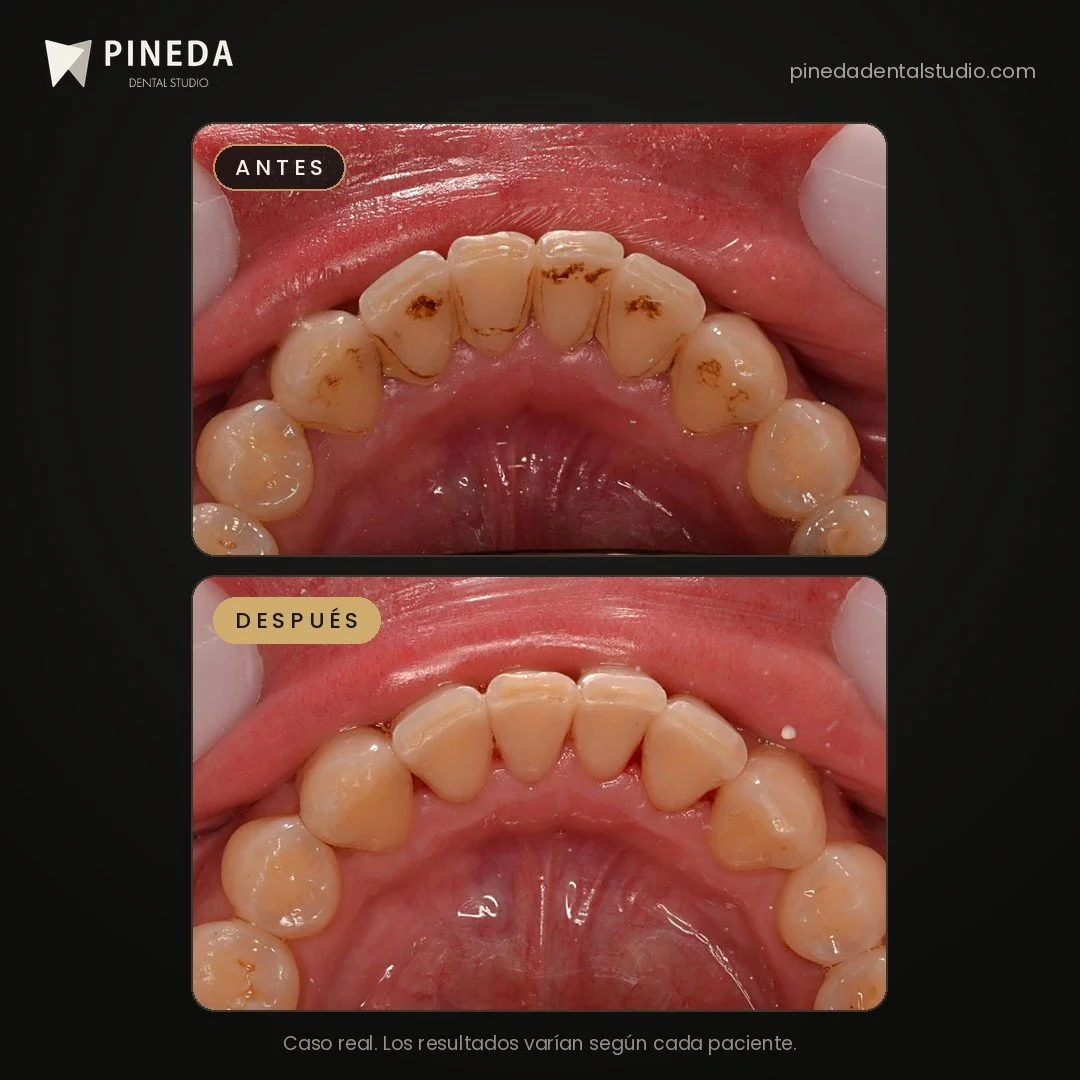
Inner surface of the lower teeth: the area where tartar and staining build up most easily, because the salivary glands open there. It's also one of the hardest surfaces to reach when brushing. The change happens in the same session.
Clinical photos taken at our clinic in Recoleta, with the same lighting and framing.
When do we recommend it?
Air polishing is part of our advanced professional cleaning protocol, and we also specifically recommend it in four situations:
If you have implants
The surface of an implant and its junction with the crown have an anatomy that calls for a gentle approach. A 12-month randomized clinical trial with 120 patients with implant crowns evaluated erythritol air polishing for implant maintenance: the erythritol group showed an 86.6% reduction in bleeding on probing and a 90.7% reduction in plaque index, with results comparable to ultrasonic instrumentation and no differences by prosthesis material (feldspathic ceramic, zirconia or lithium disilicate) (Scribante et al., Dentistry Journal, 2025). See our implants and maxillofacial surgery page.
If you're having orthodontic treatment
Brackets and wires create a geometry where biofilm builds up easily and brushing has limited access. The spray reaches around the attachments without having to press an instrument against them. If you're considering treatment, see our orthodontics and teeth alignment page.
If you're in periodontal maintenance
If you've already been through gum treatment and are in regular follow-up, low-abrasive powders also allow us to work below the gum line. See how we approach it in periodontics and gum health.
If you have heavy staining
Heavy mate, coffee or tobacco use, or stains that don't come off with home care.
Does it feel different?
Yes, and that's probably the main reason patients ask for it once they've tried it.
This advantage isn't just our subjective impression: it's been measured. A systematic review with meta-analysis of 17 randomized clinical trials evaluated glycine powder polishing in periodontal maintenance therapy and found it significantly less painful than ultrasonic scaling, with a difference of 1.48 points on the visual analog pain scale. The same study reported an additional 8% reduction in bleeding on probing compared with manual instrumentation (Zhu et al., Journal of Periodontal & Implant Science, 2021).
Add to that the warm water, the lack of vibration and the fact that there's no instrument pressed against the tooth. If you have tooth sensitivity, dental anxiety or simply little tolerance for the dental chair, the difference in experience is real.
As for clinical results, the evidence is reassuring: a systematic review published in Clinical Oral Investigations that analyzed 13 clinical studies concluded that air polishing and manual or ultrasonic instrumentation achieve the same effectiveness at controlling biofilm and reducing gum inflammation (Nascimento et al., 2021). In other words, it isn't about choosing one result over another, but about choosing the approach that best suits each mouth and each patient.
How often should you have it?
As a general guide, every six months. But the real frequency is set by the diagnosis: if you're in periodontal maintenance, have implants or are in active orthodontic treatment, you may need check-ups every three or four months. If you have a healthy mouth, good hygiene and don't drink staining drinks, you can space them out.
It's important to say it clearly: no professional cleaning replaces brushing and flossing. Biofilm reorganizes within hours. What an in-office cleaning does is reset the starting point to zero and reach the places that home hygiene, however good, can't fully access.
If it's your first time at the clinic, you can have the cleaning at your first visit, with exam and panoramic X-ray included.
Who needs an assessment first?
Air polishing is a safe procedure, but it isn't automatic for everyone. Before recommending it we assess:
- Low-sodium diets. Bicarbonate powder contains sodium; in these cases we choose erythritol or glycine.
- Significant respiratory disease. The procedure creates an aerosol, and in severe asthma or chronic lung disease we adapt the protocol.
- Enfermedad periodontal activa no tratada. Primero se resuelve la enfermedad; el aeropulido pertenece a la fase de mantenimiento, no la reemplaza.
- Lesions or ulcers in the soft tissues, which are best treated first.
- Cosmetic restorations on the front teeth, which determine which powder can be used.
In most cases, none of this rules out treatment: it only determines which powder and which protocol are used.
Frequently asked questions
Does air polishing damage enamel?
Used with the right powder and protocol, no. Low-abrasive powders such as erythritol and glycine were developed specifically to act on biofilm without wearing tooth tissue. Bicarbonate, which is more abrasive, is reserved for healthy enamel and stains that justify it, with limited application times.
Will it hurt?
Generally, no. The available evidence shows it's significantly less painful than ultrasonic scaling. There may be a slight fresh feeling or a sense of spray, which most patients describe as comfortable.
Will it make my teeth whiter?
It restores the tooth's natural color by removing staining on the surface. It doesn't lighten it beyond that: changing the tooth's own shade requires whitening.
Can it be done with braces or implants?
Yes, and those are two of its best uses, always with low-abrasive powders.
How long is the session?
The air polishing step itself is short. The total length of the visit depends on the full protocol: diagnosis, tartar removal when needed and final polishing.
Does it replace the cleaning I used to have?
It doesn't replace it: it's a distinct protocol within our professional cleaning, which we recommend depending on the case. At an assessment visit we decide what your mouth needs.
A cleaning needs a diagnosis too
Behind something as routine as a dental cleaning there are clinical decisions: what type of deposit needs removing, from which surfaces, with what level of abrasiveness and how often. The air polisher widens that range and lets us work more precisely on mouths that used to take more time and more discomfort.
If you have implants, braces, stains that won't budge, or you simply want a more comfortable professional cleaning, the first step is an assessment.
Ayacucho 1230, Recoleta · We reply the same day
📍 We look forward to seeing you at our clinic in Recoleta, Buenos Aires.
👩🏻⚕️ About the author and clinical director
Od. Mariana Pineda is a dentist (José Antonio Páez University, 2014) and trained in fixed, removable and implant-supported prosthodontics at the Argentine Dental Association (2018). As clinical director of Pineda Dental Studio, she leads a multidisciplinary team of more than 10 dentists in oral rehabilitation, cosmetic dentistry, implants and maxillofacial surgery, following international protocols for minimally invasive dentistry.
Medical notice: the information in this article is for educational purposes. The professional cleaning protocol and choice of powder depend on the individual clinical diagnosis we make at the clinic.
📚 Scientific sources consulted
- Nascimento, G. G., Leite, F. R. M., Pennisi, P. R. C., López, R., & Paranhos, L. R. (2021). Use of air polishing for supra- and subgingival biofilm removal for treatment of residual periodontal pockets and supportive periodontal care: a systematic review. Clinical Oral Investigations, 25(3), 779–795.
- Zhu, M., Zhao, M., Hu, B., Wang, Y., Li, Y., & Song, J. (2021). Efficacy of glycine powder air-polishing in supportive periodontal therapy: a systematic review and meta-analysis. Journal of Periodontal & Implant Science, 51(3), 147–162.
- Scribante, A., et al. (2025). Effectiveness of erythritol-based air polishing and ultrasonic instrumentation with PEEK inserts in peri-implant maintenance: a randomized clinical trial including different prosthetic materials. Dentistry Journal, 13(6), 235.
- Ludovichetti, F. S., Lucchi, P., Bernardelle, M., Signoriello, A. G., Pezzato, L., Bertolini, R., Gallo, M., & Mazzoleni, S. (2024). Comparative effects of different abrasives on surface roughness of dental materials: an in vitro study. Applied Sciences, 14(19), 8956.
