
By: Od. Mariana Pineda | Reading time: 5 minutes
Waking up with a headache, a tense neck or a tired jaw, or noticing that your teeth look shorter and more worn every time. These are the silent symptoms of a modern epidemic: bruxism.
Today's pace of life, stress and sleep disturbances make us clench or grind our teeth unconsciously, putting destructive forces on our mouth. At Pineda Dental Studio, with a comprehensive rehabilitation and maxillofacial surgery team, we know that treating bruxism takes much more than simply "giving the patient a piece of plastic to bite on".
Bruxism doesn't just destroy tooth enamel: it directly affects the facial muscles and the temporomandibular joint (TMJ), the hinge that connects the jaw to the skull. Here are the three advanced lines of treatment we use at our clinic to restore health and comfort to your chewing system.
1. Muscle-relaxing night guards: why the material changes everything
The first step to protect your teeth and relax your muscles is wearing an occlusal splint. But there's a very common mistake: soft silicone guards. Soft guards are counterproductive for bruxism, because the brain reads them as something to chew (like gum) and they encourage even more clenching.
At Pineda Dental Studio we design and make rigid muscle-relaxing night guards (heat-cured acrylic or 3D printed). Their benefits are clear:
Muscle deprogramming: because they're rigid and have a smooth surface adjusted to the millimeter, they force the jaw muscles to relax.
Full protection: they act as a shield that absorbs the impact of night-time biting and prevents fractures and premature wear of your natural teeth or your porcelain crowns.
Rigid muscle-relaxing night guard
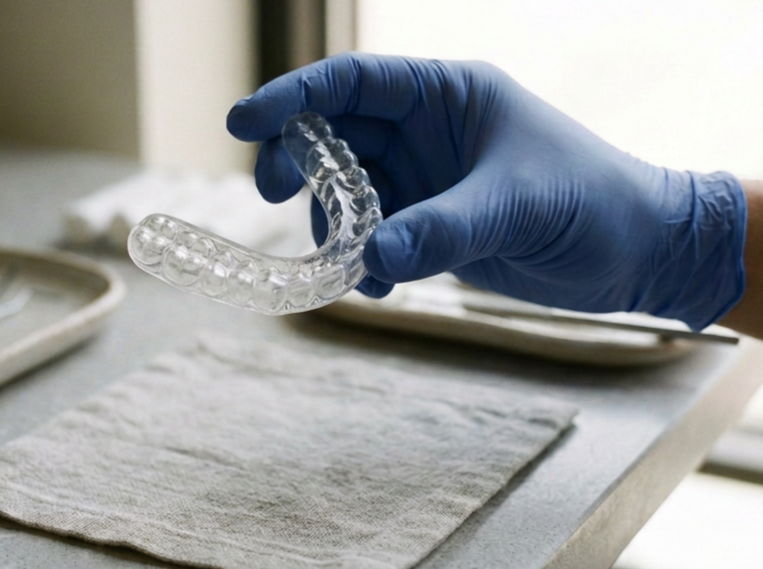
Rigid guards protect the teeth and help relax the muscles; soft ones, on the other hand, tend to encourage clenching.
Illustrative image.
2. Therapeutic botulinum toxin
In patients with severe bruxism, the masseter muscles (which close the jaw) become hypertrophied: excessively large and strong. In these cases, a night guard alone isn't enough to relieve muscle pain.
Applying botulinum toxin to the masseter and temporal muscles is a groundbreaking, minimally invasive treatment.
Pain relief: the toxin temporarily relaxes the strength of the muscle and keeps you from clenching hard at night, which relieves headaches and facial fatigue. It doesn't affect your ability to speak or chew at all.
Cosmetic benefit: as the hypertrophied muscle relaxes, it shrinks, slimming the lower third of the face and giving a more sculpted profile (similar to the effect of buccal fat removal).
At our clinic
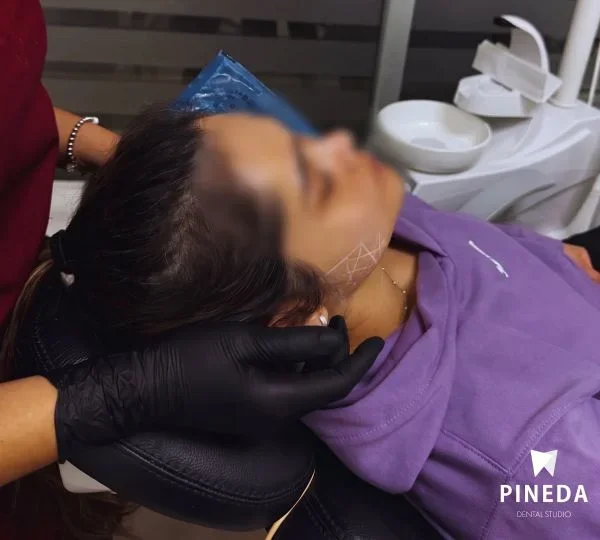
Botulinum toxin applied to the masseter muscle to relieve jaw tension.
3. Joint injections (TMJ)
When bruxism progresses unchecked, the damage reaches the joint (TMJ). It shows up as clicking (noises when opening or closing the mouth), sharp pain near the ear or even episodes where the jaw "locks".
With our maxillofacial surgery team we perform intra-articular injections, a quick in-office procedure to treat the joint directly from the inside:
Corticosteroid injection: used in acute phases to reduce inflammation quickly and relieve severe pain right away.
Hyaluronic acid injection: acts like a "lubricating oil" for the joint. Hyaluronic acid nourishes the cartilage, reduces friction between the bones and the joint disc, and significantly improves jaw mobility.
A comprehensive maxillofacial approach
Bruxism isn't cured, it's managed. Our goal is to diagnose exactly how much damage your chewing system has in order to design a tailored plan that combines the mechanical protection of night guards with muscle relaxation and joint therapy.
When wear has already damaged the teeth, we rebuild them in oral rehabilitation, and TMJ cases are assessed together with our maxillofacial surgery team.
If you wake up in pain or have noticed your teeth losing their original shape, it's time to stop the wear.
Frequently asked questions
Can bruxism be cured?
It isn't cured, it's managed. The goal is to protect the teeth and the joint.
Which night guard is best?
A rigid, custom-made guard. Soft guards can be counterproductive.
What is botulinum toxin used for?
It's applied to the masseter and temporal muscles to reduce clenching force. The effect usually lasts 4 to 6 months. Afterwards we assess whether it needs to be repeated.
What are TMJ injections?
They're applications inside the joint. In the acute phase, when there's a lot of inflammation and pain, corticosteroids are used. Hyaluronic acid is used to lubricate the joint when there's wear, noises or the jaw locks. We recommend them after assessing the TMJ, and always together with a night guard.
How much does it cost?
It depends on the combination of treatments. We'll tell you after the assessment.
📍 We look forward to seeing you at our clinic in Recoleta, Buenos Aires.
About the author and clinical director
Od. Mariana Pineda is a dentist (José Antonio Páez University, 2014) and trained in fixed, removable and implant-supported prosthodontics at the Argentine Dental Association (2018).
As clinical director of Pineda Dental Studio, she leads a multidisciplinary team of more than 10 dentists in oral rehabilitation, implants and maxillofacial surgery, following international protocols for treating orofacial pain and bruxism.
Medical notice: the information in this article is for educational purposes. The choice of treatment (night guards, botulinum toxin or injections) depends on the individual clinical diagnosis we make at the clinic.
Scientific sources consulted
De la Torre Canales, G., et al. (2020). "Botulinum toxin type A applications for masticatory myofascial pain and bruxism: a systematic review." Journal of Oral Rehabilitation.
Goiato, M. C., et al. (2016). "Use of hyaluronic acid in temporomandibular joint dysfunction: A systematic review." Journal of Cranio-Maxillofacial Surgery.
Okeson, J. P. (2019). Management of Temporomandibular Disorders and Occlusion. Elsevier.
