
There's one word that changes any patient's face in the chair: root canal. Almost everyone has a story (their own, a parent's, a friend's) of a long treatment, several sessions, files you could feel one by one and pain that lasted for days. That story was real. It's just from another era.
Root canal treatment has changed more in the last fifteen years than in the previous fifty. Hand-moved steel instruments have been replaced by motor-driven nickel-titanium files; canal length is measured with an electronic device instead of being estimated from an X-ray; cleaning is completed with activated irrigation and, in our case, with a laser. The result is a shorter, more predictable treatment with a much easier recovery.
We wrote this article together: one of us as clinical director and the other as the endodontist who does these treatments every day at Pineda Dental Studio. We explain exactly what rotary endodontics is, what the step-by-step process is like at our clinic, how it differs from the manual technique and why we added the diode laser to the protocol.
In short
A root canal treatment cleans, disinfects and seals the inside of the root when the pulp has become inflamed or infected, in order to save the tooth. Rotary endodontics does that cleaning with nickel-titanium files moved by a controlled motor: it's faster and better respects the canal's original shape than steel hand files. In our protocol we add an electronic apex locator, activated irrigation, diode laser decontamination and warm (thermoplastic) filling, and we finish with photobiomodulation for a calmer recovery. A tooth that's treated well and restored well survives 86% to 93% of the time at 2–10 years. What weighs most in that number isn't the sealing technique: it's the cleaning and, above all, the final restoration.
What exactly is a root canal treatment?
Inside every tooth there's a soft tissue (the pulp) with nerves and blood vessels, which fills a chamber in the crown and one or more fine canals along the roots. When deep decay, a fracture or a blow reaches it, the pulp becomes inflamed and then infected. That's root canal pain: an inflamed tissue inside a rigid space that leaves it no room to swell.
Treatment consists of removing that tissue, cleaning and disinfecting the canals along their full length, and sealing them so they don't become colonized again. The tooth is left without pulp but stays anchored to the bone by its ligament, and with a good restoration on top it works for decades. The alternative is extracting it, and we've already explained in the article on implants what happens to the bone when a tooth is missing. That's why, whenever a tooth can be saved, we save it.
What does "rotary endodontics" mean?
It means the canals are cleaned with nickel-titanium files driven by a motor that controls speed and force, instead of stainless steel files the dentist moves by hand. It sounds like a technical detail, and it's the central difference between the root canal of the past and today's.
Steel hand files are rigid. In a curved canal (and most are), they tend to straighten it, stray from its original path and leave areas untouched. Nickel-titanium is a metal with elastic memory that bends and follows the curve of the canal, and the motor rotates or alternates it with limited torque, which reduces the risk of forcing it. A systematic review with meta-analysis published in the Journal of Evidence-Based Dental Practice compared both systems and found that rotary nickel-titanium instruments produce less canal transportation (that is, they better respect its original shape) and less extrusion of debris beyond the root than steel hand files (Del Fabbro et al., 2017).
In practice, that translates into three things the patient does notice: less time with your mouth open, fewer sessions and a recovery with less discomfort, because less infected material is pushed into the bone.
Endodontics · Pineda Dental Studio
Rotary and manual, compared
It's not that the manual technique is wrong: the rotary one does the same with more control. The manual technique still has a place, and we'll tell you where.
| Aspect | Manual | Rotary | What changes for you | What the evidence shows |
|---|---|---|---|---|
| Instruments What the canal is cleaned with. | Rigid stainless steel files, moved by hand one by one. | Flexible nickel-titanium files, driven by a motor with controlled torque. | Less of a "scraping" sensation and less time in the chair. | Nickel-titanium better respects the canal's original curvature (Del Fabbro et al., 2017). |
| Canal shapeKey How well the anatomy is respected. | Tends to straighten curves and leave areas uncleaned. | Follows the curve; cleans more evenly. | Less risk of hidden bacteria remaining and of the treatment failing. | Less transportationA consistent result in comparative studies. |
| Debris pushed into the bone What gets pushed beyond the root. | More extrusion of infected debris. | Less extrusion. | Less inflammation and discomfort in the following days. | Less extrusion |
| Time and sessions How long treatment takes. | Longer; often several appointments. | Shorter; many cases in one or two appointments. | Fewer visits and less time with your mouth open. | One appointment or several: the long-term result is the same (Mergoni et al., 2022). The case decides. |
| Where manual is still useful It hasn't disappeared. | To explore and open up very narrow or calcified canals before the rotary file. | Takes over once the canal is open. | Nothing you'll notice: both are combined in the same treatment. | Nickel-titanium files have a somewhat higher fracture rate, which is why they're used with controlled torque and discarded after a few uses. |
Rotary endodontics isn't just "with a motor". It's a complete protocol: electronic length measurement, controlled instrumentation, activated irrigation, disinfection and three-dimensional sealing. The motor is the visible part.
Comparative evidence in humans is still limited and the authors ask for it to be interpreted with caution; the strongest advantages are those relating to shape and extrusion.
What is the step-by-step process like at Pineda Dental Studio?
This is what a root canal treatment at our clinic is like, from start to finish. We go into detail because, for most patients, knowing what's going to happen is half the relief.
- Diagnosis and initial X-rayWe confirm the tooth needs the treatment, how many canals it has and what their curves are like. The initial X-ray is included and is the reference we compare against at the end.
- Anesthesia and isolationLocal anesthesia and a rubber dam that isolates the tooth: we work dry, without saliva, and you don't taste the solutions or risk swallowing anything.
- OpeningThe pulp chamber is accessed through the crown and the canal entrances are located.
- Measurement with an electronic apex locatorA device that measures the exact length of each canal from the difference in conductivity between the inside of the tooth and the surrounding tissue. Systematic reviews report an accuracy of 80% to 95% within half a millimeter, better than an X-ray alone (Alarifi et al., 2025). Working to the right length avoids falling short, which leaves infection, and going too far, which irritates the bone.
- Rotary instrumentationThe nickel-titanium files, moved by the motor, shape the canal following its curve. In very narrow canals, the way is first opened with a hand file.
- Activated irrigationThe disinfecting solution (sodium hypochlorite) is agitated inside the canal with ultrasonic energy so it reaches the corners no file can get into: branches, isthmuses and dentin tubules. This is the stage that removes the most bacteria.
- Diode laser decontaminationA very fine optical fiber travels along the already-cleaned canal, and the laser energy penetrates the dentin a few millimeters beyond where liquids reach. We explain the evidence below.
- Warm fillingThe canal is sealed with warm gutta-percha, which flows and adapts to irregularities and lateral canals in three dimensions, instead of being compacted cold.
- Photobiomodulation and temporary fillingLow-power laser on the gum and bone in the area to reduce inflammation and post-treatment discomfort, and a temporary seal that lasts 7 to 15 days.
- Final X-ray and permanent restorationThe seal is checked and we plan the restoration that will protect the tooth: composite, inlay or crown depending on how much tooth is left. This stage isn't optional, and we'll explain why.
Why do we use a laser in the root canal?
We use it at two moments and with two different goals, and it's worth separating them because the evidence is different for each.
To decontaminate the dentin
The underlying problem in every root canal is that bacteria aren't only in the central space: they get into the dentin tubules, microscopic channels that run through the root wall. Files don't reach them and liquids only reach a certain depth. The diode laser, applied with a fine fiber inside the canal after instrumentation and irrigation, transmits heat energy through the dentin and reaches bacteria that were beyond the reach of everything else.
A clinical study published in Frontiers in Medicine in 2026 compared, in 102 patients with confirmed Enterococcus faecalis infection (the most resistant bacterium in root canals), irrigation with hypochlorite alone versus hypochlorite plus an 810 nm diode laser. Elimination of the bacterium was 92.2% with the laser versus 74.5% without it, and clinical success at six months was 90.2% versus 76.5% (Lu et al., 2026). It's a retrospective, single-center study, so we read it with caution, but it points in the same direction as what we see at the clinic.
And here's the part that matters: the laser doesn't replace chemical cleaning. A study that used it as the only disinfectant, instead of hypochlorite, found that in teeth with a prior lesion the success rate on CT was low, especially in retreatments (Pedraza et al., 2025). That's why in our protocol the laser comes after activated irrigation, as an extra layer of safety, and never instead of it. If someone offers you a "laser root canal" as if the laser did the cleaning, ask what else they use.
For a calmer recovery
The second use is photobiomodulation: the same laser, at low power and from the outside, on the gum and bone around the root. It doesn't cut or heat; it modulates the tissues' inflammatory response. Systematic reviews with meta-analysis published in 2024 found that photobiomodulation reduces pain after root canal treatment, with the clearest effect between 24 and 72 hours, which is exactly the most uncomfortable period (Toopalle et al., 2024; Kadam et al., 2024). The authors themselves note that the benefit depends on using standardized parameters, which is why we apply it with a fixed protocol.
It's the same laser we use in other treatments at the clinic; if you want to know more about it, we explain it on our laser dentistry page and in the article on the diode laser.
At the clinic · Pineda Dental Studio
The diode laser we use at the clinic
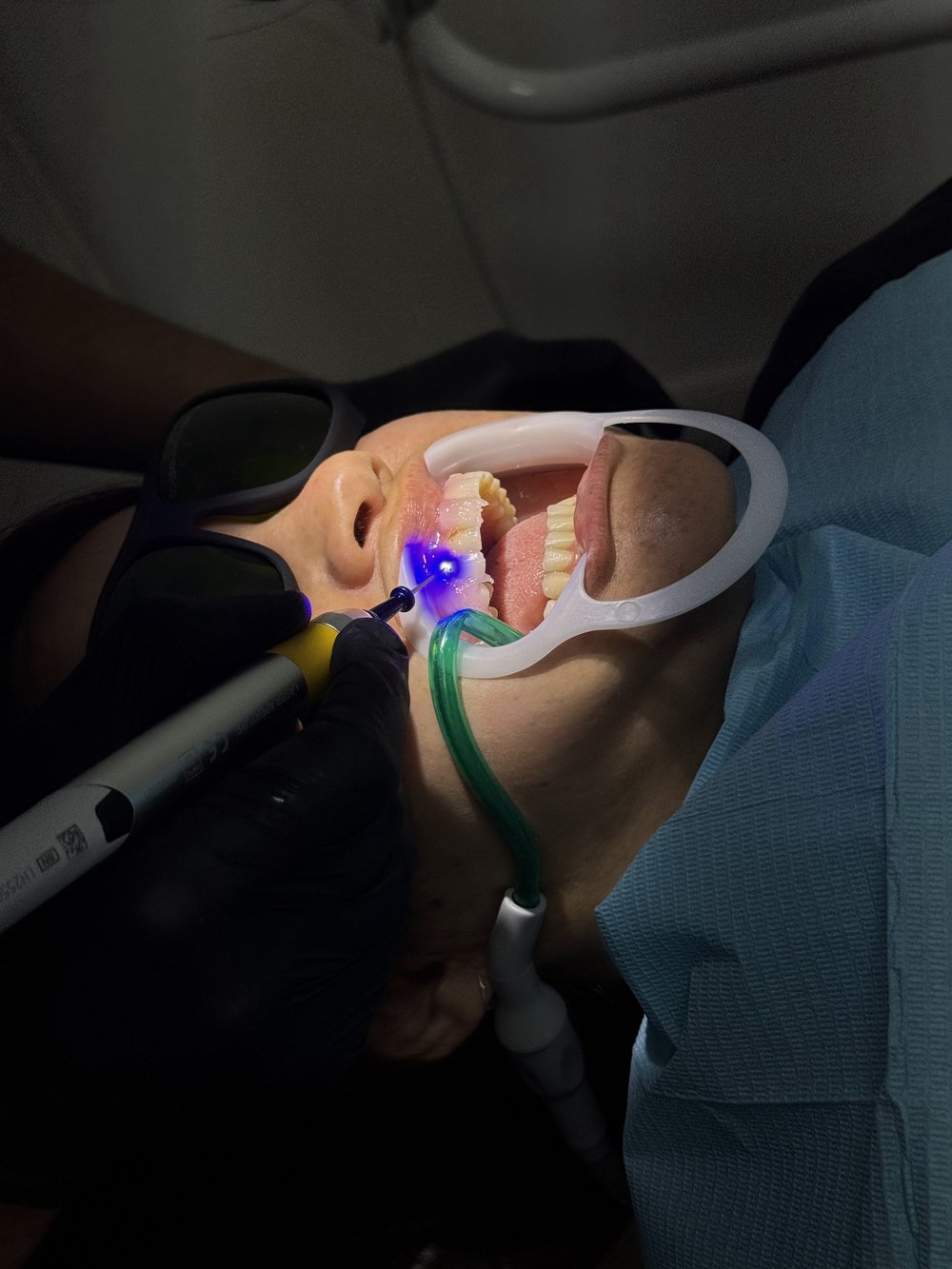
It's the same diode laser unit we use in other treatments at the clinic. In the root canal it's used with a very fine optical fiber that travels along the already-cleaned and irrigated canal, and its energy passes through the dentin to reach bacteria that liquids can't. From the outside and at low power, the same laser is used afterwards for photobiomodulation.
Photo taken at our Recoleta clinic, with the patient's permission.
Endodontics · What the evidence says
Three numbers behind the protocol
Every stage of treatment has data behind it. These are the three that best explain why we do it this way.
Versus 74.5% with irrigation alone, in patients with confirmed E. faecalis (Lu et al., 2026).
Within half a millimeter of the canal's real length (Alarifi et al., 2025).
Survival at 2–10 years after root canal treatment, in a review of 14 studies (Ng et al., 2010).
The number that depends most on you is the third. The factor with the most influence on survival wasn't the technique: it was having a crown or permanent restoration after treatment.
Does it hurt? And afterwards?
During treatment, you shouldn't feel pain: we work under local anesthesia and, in teeth with acute inflammation, with complementary techniques until the tooth is properly numb before starting. What you will feel is pressure, slight vibration from the motor and the time with your mouth open.
Afterwards, moderate discomfort when chewing for two or three days is normal, because the bone around the root was inflamed and needs to settle. Rotary instrumentation helps because it pushes out less debris, and photobiomodulation targets exactly that period. If the pain is severe, gets worse after the third day or there's swelling, that's not expected: message us and we'll see you.
One appointment or two?
It depends on the tooth and its condition, not on a fixed rule. A Cochrane review of 47 studies and more than 5,800 patients found that finishing the root canal in one visit or several doesn't change the long-term result, and that doing it in one visit is associated with slightly more pain in the first week, with moderate-certainty evidence (Mergoni et al., 2022).
In our practice, that means: a vital tooth without infection is usually done in one appointment. A tooth with an established infection, pus or a large lesion in the bone often benefits from medication inside the canal between two appointments, so the canal is in better condition when it's sealed. We decide with the X-ray and with what we find when we open it, and we explain it to you at the time.
Real case · Pineda Dental Studio
Root canal in an infected tooth
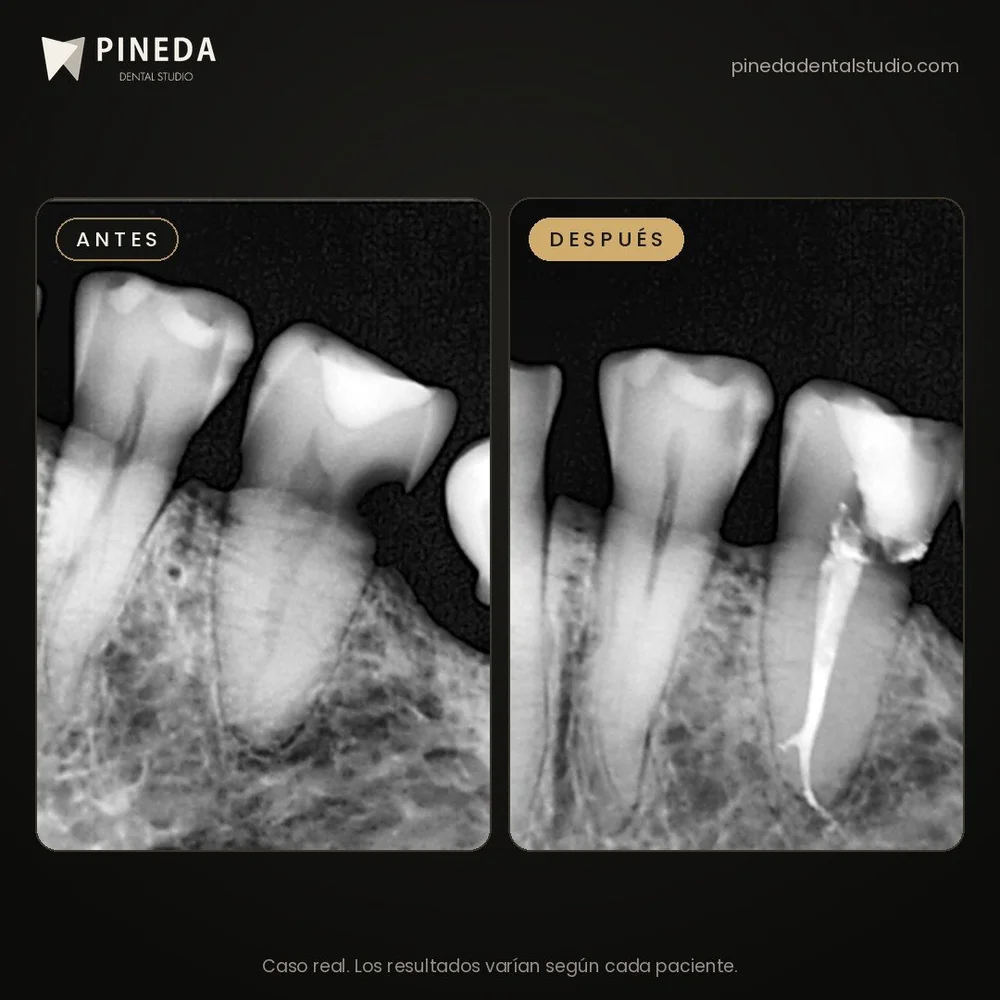
On the left, the infected tooth before treatment. On the right, the canal cleaned and sealed along its full length, with the tooth already restored. The final X-ray is what lets us check the seal before considering the treatment finished.
Real case treated at our clinic in Recoleta, with the patient's consent. Results vary from person to person.
What does treatment include, and what happens afterwards?
So there are no surprises, this is what's part of root canal treatment at Pineda Dental Studio:
- The initial and final X-rays.
- Laser decontamination and post-treatment photobiomodulation.
- The temporary filling, which seals the tooth between the root canal and the permanent restoration. It lasts 7 to 15 days.
- The diagnostic visit is included when the treatment is carried out.
Two things we'll repeat, because they have the biggest effect on the result:
If the temporary filling falls out or breaks, come in right away. It's not a pain emergency, but it is a time emergency: a sealed canal left open to saliva becomes contaminated again within a few days, and that can mean redoing part of the work.
After a root canal, a permanent restoration always follows. A tooth without pulp is drier and more fragile, and the opening made to treat it weakens it further. The systematic review by Ng and colleagues identified the crown or permanent restoration as the factor with the greatest influence on the tooth staying in place years later, above any other (Ng et al., 2010). Depending on how much tooth is left, that restoration is a composite, an inlay or a crown; we plan it with our restorative dentistry area and coordinate it so little time passes between one and the other.
How long does a tooth with a root canal last?
A long time, if the two conditions above are met. The systematic review in the International Endodontic Journal that brought together 14 studies found survival of 86% at 2–3 years, 93% at 4–5 and 87% at 8–10 (Ng et al., 2010). And the factors that improved it most were, in order: having a crown after treatment, keeping contacts with the neighboring teeth, not using the tooth as a support for a prosthesis, and not being a molar.
Notice that the filling technique and the brand of files don't appear on that list. We say it frankly even though we use warm filling and consider it a better seal: the available evidence indicates that what defines the prognosis is the quality of the cleaning and the final restoration, more than the method used to fill the canal. That's why the protocol puts the weight where the evidence is, and why we insist so much on the restoration.
Real case · Pineda Dental Studio
Root canal in a molar with curved roots
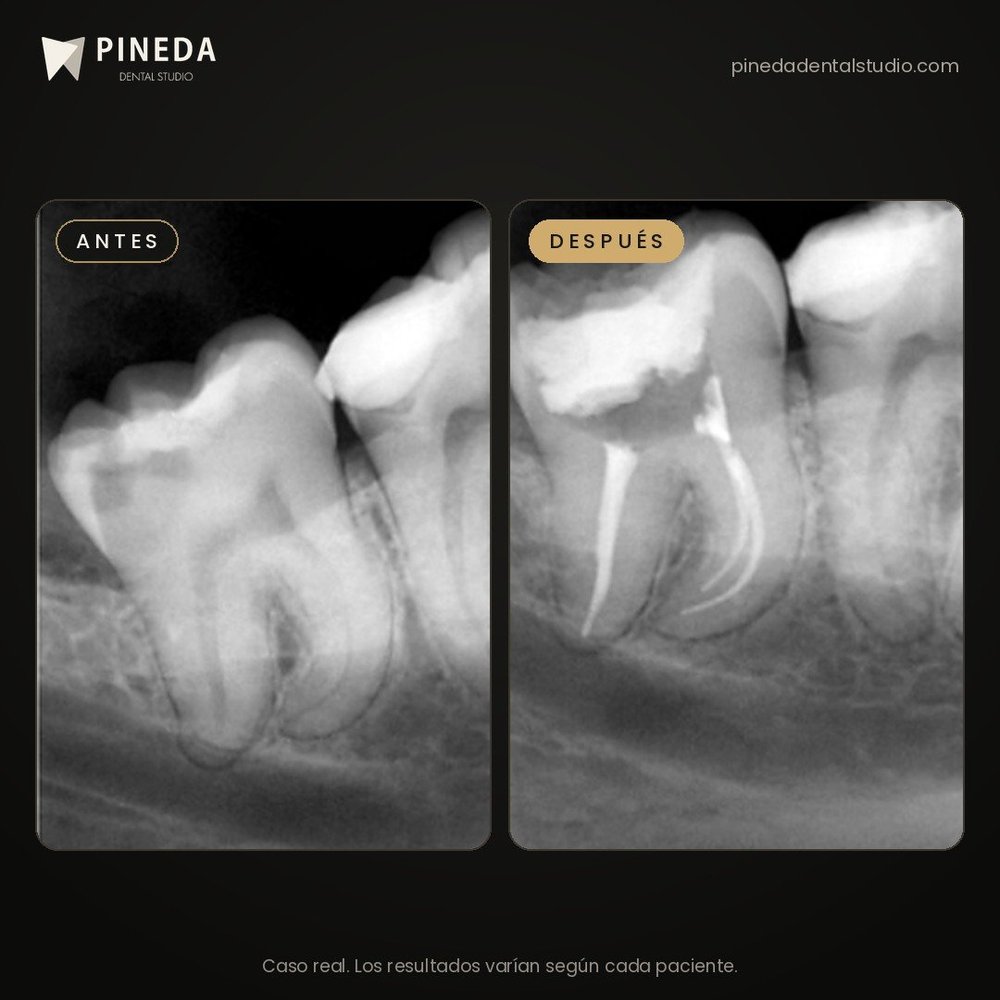
On the left, the tooth before treatment. On the right, the canals sealed along their full length, following their original curve. That continuous seal down to the tip of the root is what we aim for with electronic measurement and warm gutta-percha.
Real case treated at our clinic in Recoleta, with the patient's consent. Results vary from person to person.
Real case · Pineda Dental Studio
From the root canal to the permanent restoration
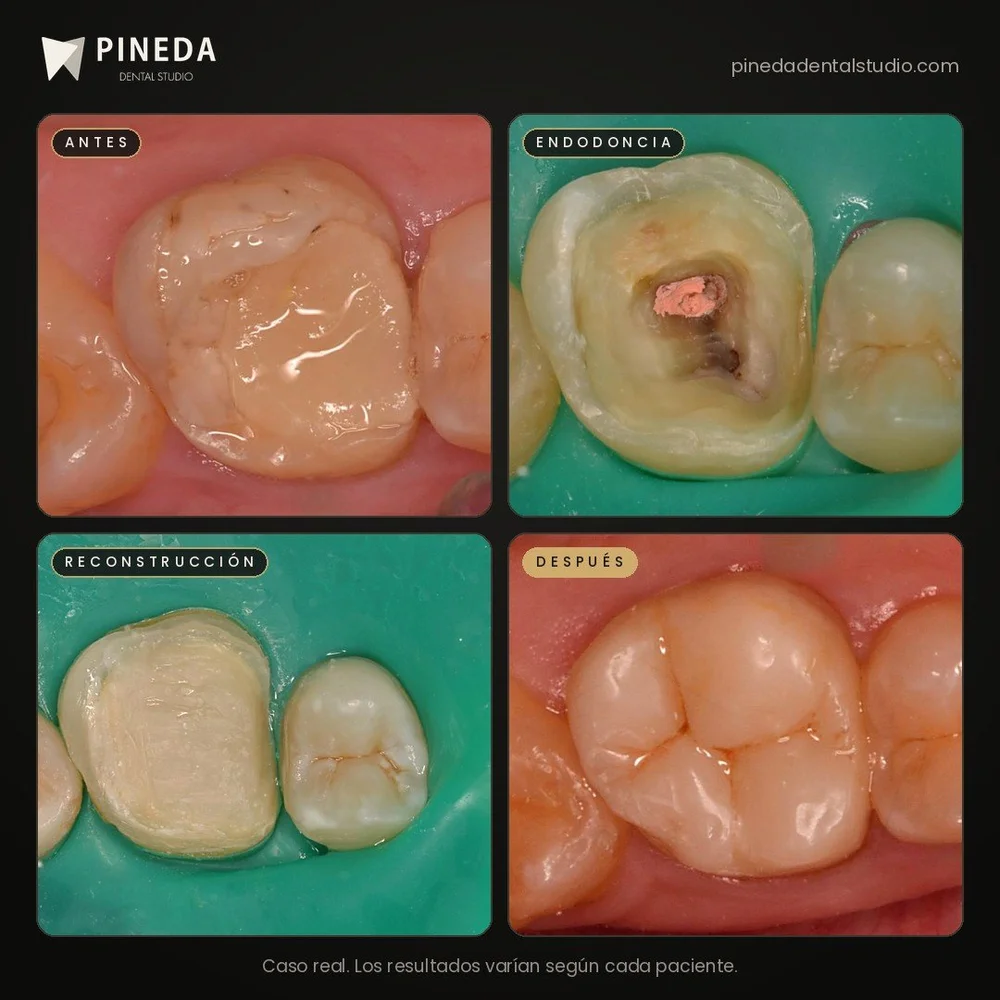
The full sequence in a molar: how it arrived, the root canal with the tooth isolated by a rubber dam, the rebuild and the final result. This last stage is what closes and protects the tooth, and it's what matters most for it to stay in place for many years.
Real case treated at our clinic in Recoleta, with the patient's consent. Results vary from person to person.
Frequently asked questions
Does a root canal hurt?
During treatment, under local anesthesia, you shouldn't feel pain; you will feel pressure and vibration. Afterwards, moderate discomfort when chewing for two or three days is normal. Severe pain, or pain that gets worse after the third day, isn't, and you should get in touch.
How long is the appointment?
Between 60 and 90 minutes in most cases, depending on the tooth: an incisor with one canal is quicker than a molar with three or four.
Can I eat afterwards?
Once the anesthesia wears off, yes, avoiding chewing on that tooth until it has its permanent restoration. The temporary filling protects it, but it isn't made for full chewing force.
What if my temporary filling falls out?
Come in right away. The canal is exposed to saliva and gets recontaminated within a few days. It's not a pain emergency, but it is a time emergency.
Why do I need a crown if the tooth doesn't hurt anymore?
Because a tooth without pulp is more fragile and the opening weakened it. The permanent restoration is the factor with the most influence on the tooth still being there at ten years. Leaving the temporary filling for months is the most common way to lose a well-done root canal.
Does the laser replace cleaning with hypochlorite?
No. It's an extra layer of disinfection that comes after irrigation, not instead of it. Used alone, the evidence shows poor results.
Can a root canal be done on a tooth that's already had one?
Yes, it's called retreatment. The previous filling is removed, the canal is cleaned again and resealed. It's more complex and its prognosis is somewhat lower than a first treatment, but in many cases it allows the tooth to be saved.
Does a tooth with a root canal turn dark?
It can happen over time, especially in front teeth, because of tissue or material left inside the chamber. It's prevented by cleaning the chamber well and fixed with internal whitening or a cosmetic restoration.
Saving the tooth is always the first option
A well-done root canal isn't the end of a tooth: it's what lets it stay in your mouth for decades. Rotary instrumentation, the apex locator, activated irrigation, the laser and warm filling are the tools; the underlying decision is the same as always: before extracting, try to save it.
If you've been told you need a root canal, or you have a tooth that hurts with cold, heat or when chewing, the first step is a diagnosis with an X-ray. Then we'll tell you exactly what we're going to do, in how many appointments and what comes next.
Ayacucho 1230, Recoleta · We reply the same day
📍 We look forward to seeing you at our clinic in Recoleta, Buenos Aires.
👩🏻⚕️ About the authors
Od. Beatriz León (M.N. 43.697) is the endodontist at Pineda Dental Studio. She performs the clinic's root canal treatments and retreatments using the protocol described in this article: rotary endodontics, apex locator, activated irrigation, diode laser and warm filling.
Od. Mariana Pineda (M.N. 39.080) is a dentist (José Antonio Páez University, 2014) and trained in fixed, removable and implant-supported prosthodontics at the Asociación Odontológica Argentina (2018). As clinical director of Pineda Dental Studio, she leads a multidisciplinary team of more than 10 dentists in endodontics, oral rehabilitation, cosmetic dentistry, implants and maxillofacial surgery, following international protocols for minimally invasive dentistry.
Medical notice: the information in this article is for educational purposes. Whether root canal treatment is indicated, the number of appointments, the use of the laser and the type of final restoration depend on the individual clinical and X-ray diagnosis we make at the clinic.
📚 Scientific sources consulted
- Ng, Y.-L., Mann, V., & Gulabivala, K. (2010). Tooth survival following non-surgical root canal treatment: a systematic review of the literature. International Endodontic Journal, 43(3), 171–189.
- Del Fabbro, M., Afrashtehfar, K. I., Corbella, S., El-Kabbaney, A., Perondi, I., & Taschieri, S. (2017). In vivo and in vitro effectiveness of rotary nickel-titanium vs manual stainless steel instruments for root canal therapy: systematic review and meta-analysis. Journal of Evidence-Based Dental Practice. doi:10.1016/j.jebdp.2017.08.001
- Mergoni, G., Ganim, M., Lodi, G., Figini, L., Gagliani, M., & Manfredi, M. (2022). Single versus multiple visits for endodontic treatment of permanent teeth. Cochrane Database of Systematic Reviews, 2022(12), CD005296.
- Alarifi, N. A., et al. (2025). Comparative accuracy of electronic apex locators and conventional radiography for working length determination in permanent teeth: a systematic review. Cureus, 17(10), e93997.
- Lu, J., Xu, R., Tang, C., & Zhou, M. (2026). Comparative efficacy of semiconductor laser and sodium hypochlorite irrigation for elimination of Enterococcus faecalis in root canals. Frontiers in Medicine, 13, 1803478.
- Pedraza, F. H., Teves-Cordova, A. V. I., Alcalde, M. P., & Duarte, M. A. H. (2025). Impact of the use of high-power 810-nm diode laser as monotherapy on the clinical and tomographic success of the treatment of teeth with periapical lesions: an observational clinical study. Restorative Dentistry & Endodontics, 50(2), e15.
- Toopalle, S. V., Yadav, I., Gupta, A., et al. (2024). Effect of laser therapy on postoperative pain and endodontic retreatment: a systematic review and meta-analysis. International Dental Journal, 74(2), 335–342.
- Kadam, A. S., Merwade, S., Neelakantappa, K. K., Naik, S. B., Brigit, B., Bhumralkar, S. S., & Naik, B. H. (2024). Effect of laser photobiomodulation on postoperative pain in endodontics: a systematic review. Photobiomodulation, Photomedicine, and Laser Surgery, 42(1), 11–19.
