
There's a phrase we hear often at the first visit: "they took out my molar a few years ago and I never did anything because it doesn't bother me". And it's true, it doesn't bother you. The problem is that, while it doesn't bother you, the bone where that tooth used to be is disappearing. Silently, without you noticing, and permanently.
That's why this article starts with the bone, not the implant. Because understanding what happens underneath when a tooth is missing explains almost everything else: why an implant is the option that best preserves what's left, what it takes to be a candidate, what the process is really like and, above all, why an implant sometimes fails.
We wrote it with the same frankness we use at the clinic. There's good news (implants are one of the treatments with the strongest long-term evidence in all of dentistry) and there are conditions that aren't negotiable.
In short
When a tooth is lost, the bone that held it is resorbed: the evidence shows a loss of width of between 29% and 63% in the first six months. An implant is the only option that stops that process, because it loads the bone again. With good planning, survival beyond ten years is around 95%. Almost any healthy adult is a candidate, and missing bone can be rebuilt with grafts. What affects the result is something else: smoking doubles the risk of failure, untreated periodontitis increases it, and so does poorly controlled diabetes. And a truth marketing leaves out: about 1 in 5 patients with implants develops peri-implantitis, an infection that's prevented with maintenance. An implant isn't something you place and forget.
What happens to the bone when a tooth is missing?
The bone around the roots exists because there are roots. Every time you chew, the force travels through the tooth to the bone, and that stimulus is what keeps it alive and full. When the tooth goes, the stimulus goes with it, and the body starts removing bone it no longer uses.
It's not a slow loss. A systematic review published in Clinical Oral Implants Research, which brought together 20 studies in humans, found that in the six months after an extraction the bone loses between 29% and 63% of its width, and between 11% and 22% of its height, with the fastest drop in the first three to six months (Tan et al., 2012). In millimeters: almost four in width in half a year.
That has three consequences the patient doesn't see. The gum sinks in that area. The neighboring teeth start tilting into the empty space and the opposing tooth (the one above or below) starts to drift out looking for contact. And the more time passes, the less bone is left to place an implant later, which can mean a graft that wasn't needed at first.
That's why, when someone tells us "it doesn't bother me", we answer that that's exactly the problem: the damage happens without warning.
Implant, bridge, removable denture or nothing?
There are four paths when a tooth is missing, and it's worth looking at them together.
Missing tooth · Pineda Dental Studio
The four options, compared by what matters
The question isn't which is best in the abstract, but which preserves what you have and which compromises what's still healthy.
| Option | The bone | The neighboring teeth | Expected lifespan | What you should know |
|---|---|---|---|---|
| ImplantPreserves the bone An artificial titanium root with a crown on top. | Maintains itLoads the bone again. | Left untouched. | 94.6% survival beyond 10 years in the available evidence. | Requires surgery, healing time and lifelong maintenance. It's the option that best protects what's left. |
| Fixed bridge Joined crowns, supported by the teeth on either side. | Keeps being lost | They have to be filed down, even if healthy. | Good in the medium term; depends on the health of the supporting teeth. | No surgery and faster. The hidden cost is wearing down two healthy teeth and making them do the work of three. |
| Removable denture An appliance you take out to sleep and clean. | Keeps being lostSometimes faster. | They take clasps and load. | Needs frequent adjustments as the bone changes. | The most affordable and least invasive option. Less comfort and stability; useful as a temporary solution. |
| Doing nothing Leaving the gap. | Lost unchecked | They tilt; the opposing tooth drifts out. | — | It doesn't hurt, and that's why it's deceptive. Every year that passes reduces the options and may add a graft that isn't needed today. |
The implant is the only one of the four that works in the bone's favor. The others live with the loss or speed it up. That doesn't rule them out: there are cases where a bridge or a removable denture is the right decision. But it's worth choosing with this in mind.
The indication is decided with a CT scan, a clinical exam and an assessment of general health.
What exactly is an implant, and why does it fuse with the bone?
An implant is an artificial root, usually titanium and screw-shaped, placed in the bone where the tooth's root used to be. On top it has an abutment and, on the abutment, the crown you see.
What makes it all possible is a phenomenon called osseointegration: the bone doesn't reject titanium, it grows in direct contact with its surface until it's firmly anchored. There's no ligament as in a natural tooth; there's a direct bond. That process takes time (generally between two and six months depending on the area and bone quality), and it's the reason an implant can't be rushed without consequences.
It's also the reason it lasts. A systematic review of studies with at least ten years of follow-up, published in the International Journal of Oral and Maxillofacial Surgery, found a cumulative survival of 94.6% with an average follow-up of 13.4 years (Moraschini et al., 2015). Few medical treatments have numbers like that over such a long period.
Am I a candidate? What we assess before saying yes
The short answer is that most healthy adults are. The full answer is that "candidate" isn't a fixed condition but the result of an assessment, and there are things that can (and should) be resolved first.
- Growth has finished. In teenagers the bone is still changing, and an implant placed too early ends up "sunken" compared with the neighboring teeth. That's why, after a young person loses a tooth, we wait.
- Bone quantity and quality. That's what the CT scan measures: how much width and height there is, and how dense it is. If it's missing, it's regenerated; it's not an obstacle, it's one more stage.
- Healthy gums. An implant placed in a mouth with active periodontitis is more likely to be lost. The disease is always treated first.
- General health and medication. Diabetes, osteoporosis treated with certain drugs, previous radiotherapy in the area, immunosuppression. None is an automatic "no", but all of them change the planning and some need coordination with your doctor.
- Habits. Smoking is the modifiable factor that weighs most. We look at it in detail below.
- Bruxism. Clenching or grinding loads the implant with forces it wasn't designed for. It doesn't rule it out, but it calls for a protective night guard and a different crown design.
- Hygiene and commitment to check-ups. It's the least technical criterion and one of the best predictors of the result at ten years.
What if I don't have enough bone?
It's the most common question from people who lost a tooth years ago, and in the vast majority of cases the answer is that it can be rebuilt. At Pineda Dental Studio we perform the regeneration procedures that make it possible.
A bone graft replaces the lost volume with material the body gradually replaces with its own bone. It can be done at the same time as the implant, when the defect is small, or as a prior stage that needs a few months to mature before implanting. A sinus lift is the specific procedure for the upper molar area, where the sinus (an air cavity) often ends up very close after the teeth are lost and doesn't leave enough height: its floor is raised and filled with graft material to gain that height.
Neither is a minor procedure, but both are predictable and have decades of evidence behind them. What they do change is the total treatment time: a case with a prior graft can take several months longer than one without. It's another reason not to wait: the sooner a tooth is replaced, the less likely you are to need them.
Can I get implants if I smoke or have diabetes?
Both affect the outcome. Neither rules it out. But it's worth looking at the numbers, because they're very different.
Smoking
A systematic review with meta-analysis published in Medicina in 2022 brought together almost 300 studies and more than 150,000 implants. Implants placed in smokers were about twice as likely to fail as those placed in non-smokers, and lost more marginal bone around them (Mustapha et al., 2022). The mechanism is well known: smoking reduces blood flow in the gum and bone, and impairs exactly the healing osseointegration depends on.
What do we do about it? First, say it. Second, ask you not to smoke in the weeks around surgery, which is the most sensitive period. Third, closer follow-up. A smoker can have successful implants; what they can't have is the same margin for error as a non-smoker.
Diabetes
Here the key is one word: control. An updated systematic review published in the International Journal of Implant Dentistry brought together 56 publications and concluded that, under controlled conditions, diabetes isn't a contraindication for implant surgery; studies with well-controlled diabetes show success rates similar to those of patients without diabetes, while poorly controlled diabetes is associated with more implant loss in the long term and a higher risk of infection around them (Wagner et al., 2022).
In practice, we always ask whether your diabetes is under control by your doctor. If it is, we continue planning as in any other case. If you tell us it isn't under control, we ask for an HbA1c test and refer you to your doctor first; surgery is planned once control is achieved. It's not red tape: it's the difference between an implant that integrates and one that doesn't.
Why does periodontitis have to be treated first?
Because the bacteria that destroyed the bone around a tooth do exactly the same around an implant. A meta-analysis of 14 prospective studies found that patients with a history of periodontitis have almost twice the risk of losing an implant and more than twice the risk of developing peri-implantitis compared with patients without that history (Sgolastra et al., 2015).
That doesn't mean someone with a history of gum disease can't have implants. It means the order matters: first the disease is treated in our gum treatment area, it's stabilized, and only then is the implant placed. And that patient will need more frequent maintenance than average for the whole life of the implant.
What is the process like, step by step?
Timing varies from case to case, but the sequence is always the same.
- Diagnosis and planningA clinical exam and a CT scan to measure the bone in three dimensions and locate the nerve and sinus. Depending on how the implant is planned, we sometimes also do a digital scan; if it's not needed, we don't. This is where we decide whether a graft is needed, where each implant goes and what the final crown will be like.
- Preparing the mouthIf there's periodontitis, decay or infection, it's resolved first. If bone needs to be regenerated, this stage can add a few months.
- Placing the implantOutpatient surgery under local anesthesia, generally shorter and easier than people imagine. The usual recovery is a few days of moderate discomfort.
- OsseointegrationThe period when the bone grows around the implant. Two to four months in the lower jaw, four to six in the upper jaw, which is less dense. In the meantime, if the area is visible, a temporary tooth is used.
- Final crownA digital impression is taken, the crown is designed and made, and it's placed on the implant. When the case is a full arch, this stage is coordinated by our oral rehabilitation area.
- MaintenanceRegular check-ups and professional cleanings. It's the stage that never ends, and the one that decides whether the implant makes it to twenty years.
If what you need is to replace all the teeth in an arch, the path is the same but with several implants supporting a full fixed prosthesis. It's a bigger treatment, with more complex planning, and it's one of the biggest transformations we do.
Real case · Pineda Dental Studio
From healing screw to final crown
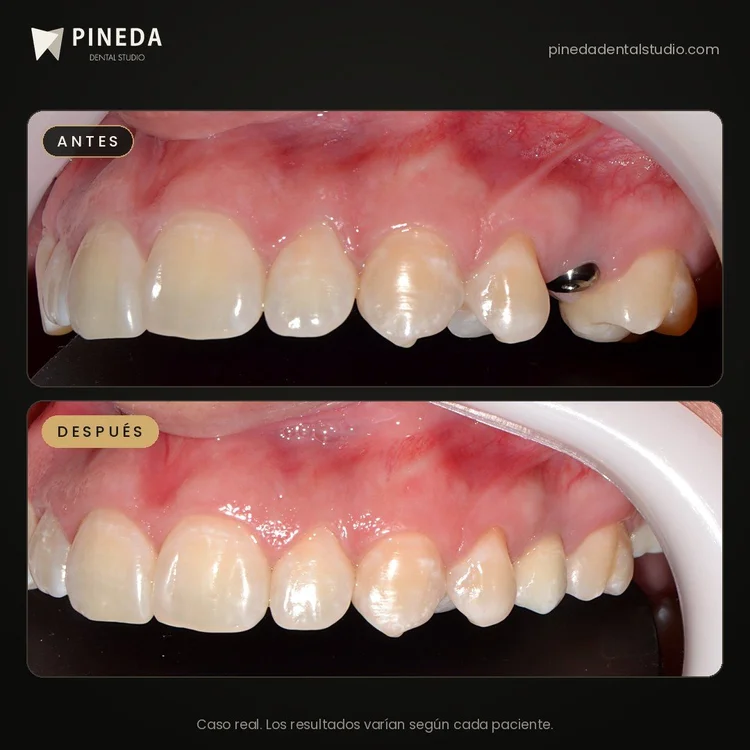
This is what the last two stages of the process look like: the implant already integrated with its healing screw and, afterwards, the final crown, aligned with the rest of the teeth in shape and color.
Real case treated at our clinic in Recoleta, with the patient's consent. Results vary from person to person.
What about "same-day implants"?
Immediate loading (placing a temporary tooth on the implant the same day as surgery) exists, and in the right cases it works. A Cochrane review of 26 clinical trials found no convincing evidence of a clinically important difference in failures between loading the implant immediately or waiting, but noted that the quality of the evidence is very low and that the essential condition is high initial stability of the implant in the bone (Esposito et al., 2013).
That's the catch in the one-size-fits-all promise. That stability depends on the bone you have, the area, the absence of infection and the absence of bruxism overloading the temporary tooth. In other words: you can't know whether it's possible until the bone is measured and, often, until the moment of surgery itself. A place that promises you "implant and tooth in one day" before seeing your CT scan is selling a technique, not recommending it.
The right questions, wherever you're treated, are two: what happens if, during surgery, the implant doesn't reach the necessary stability, and who decides that. If the answer is "we load it anyway", be wary.
Why does an implant fail?
Let's talk numbers before blame.
Implants · What the evidence says
Three numbers to keep in mind
Implants work very well and, at the same time, they're not invulnerable. Both things are true at once.
Cumulative survival in studies with an average follow-up of 13.4 years (Moraschini et al., 2015).
Prevalence of 22% in patients with implants; mucositis, its earlier stage, reaches 43% (Derks & Tomasi, 2015).
Meta-analysis of more than 150,000 implants (Mustapha et al., 2022).
Most late failures aren't caused by the implant: they're caused by what happens around it. Bacteria, smoking, excessive load and lack of check-ups. All of that can be worked on.
Failures fall into two groups. Early failures, in the first few months, happen when the implant doesn't integrate: because of infection, lack of initial stability, poor-quality bone or loading it too soon. They're uncommon and are generally resolved by removing the implant, waiting and placing it again.
Late failures are another story, and they almost always have a name: peri-implantitis. It's an infection of the tissues around an implant that has already integrated, which inflames the gum and destroys the supporting bone. A systematic review of its epidemiology published in the Journal of Clinical Periodontology estimated that it affects about 22% of patients with implants, and that its earlier stage, peri-implant mucositis, reaches 43% (Derks & Tomasi, 2015). One in five. It's not rare.
What causes it is the same thing that causes periodontitis: bacterial plaque that isn't removed. What makes it worse: smoking, poorly controlled diabetes, a history of gum disease, poorly designed crowns that make cleaning hard, and bruxism that overloads the implant. And what prevents it is, above all, one thing: maintenance.
How do you care for an implant so it lasts?
Just like a tooth, but with less margin. A natural tooth has a ligament that defends it and warns you with pain; an implant has neither, and that's why peri-implantitis progresses silently until there's already bone loss.
- Brushing and cleaning between teeth every day, paying special attention to where the crown meets the gum.
- Regular professional check-ups, with probing of the tissues around the implant and X-rays to detect bone loss before it shows.
- Cleanings with the right instruments. The implant surface can't be scratched with the same instruments used on a tooth. That's why we use air polishing with erythritol powder, which cleans without damaging the titanium or the crown.
- A night guard if there's bruxism, no exceptions.
- Not smoking, or at least knowing that if you smoke, follow-up needs to be more frequent.
We set the frequency of check-ups according to each patient's risk: every six months in the best case, every three or four in patients with a history of gum disease, smokers or those with full-arch rehabilitations.
Real case · Pineda Dental Studio
Two implants with their crowns in the upper jaw
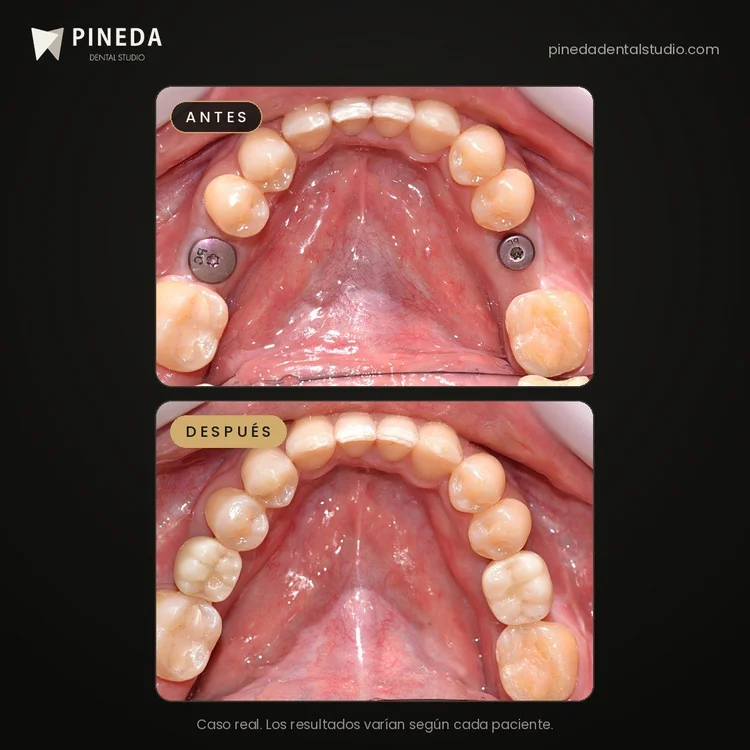
One implant on each side of the upper jaw: from the healing screws to the final crowns, which complete the arch with the shape and color of natural teeth.
Real case treated at our clinic in Recoleta, with the patient's consent. Results vary from person to person.
Frequently asked questions
Does getting an implant hurt?
Surgery is done under local anesthesia and most patients describe it as easier than an extraction. In the following days there's moderate discomfort and swelling, controlled with the prescribed medication.
How long does the whole treatment take?
From surgery to the final crown, between three and six months in a case without a graft. If bone needs to be regenerated first, it can add several more months. The planning beforehand takes a few weeks.
How long does an implant last?
Evidence beyond ten years shows survival close to 95%. With good maintenance, the reasonable expectation is decades. The crown on top may need replacing before the implant does.
Can I get an implant the same day the tooth is taken out?
Sometimes, yes: it's called an immediate post-extraction implant, and it depends on there being no infection and enough bone left to stabilize it. It's decided with the CT scan and confirmed at the time of the extraction.
What if I smoke?
You can get implants, but with about twice the risk of failure. We ask you not to smoke in the weeks around surgery and we schedule more frequent check-ups.
Does diabetes stop me from getting one?
No, if it's under control. We always ask whether your doctor has it under control. If not, we ask for an HbA1c test and refer you to your doctor first before planning surgery.
Am I too old for an implant?
There's no age limit. What matters is general health, medication and bone quality, not your date of birth. There are patients over 80 with successful implants.
Can an implant be "rejected"?
Titanium doesn't cause immune rejection. What can happen is that it doesn't integrate, because of infection, lack of stability or loading too early, or that years later it's lost to peri-implantitis. Both are prevented with planning and maintenance.
The best time was when you lost the tooth; the second best is now
Every month that passes without replacing a tooth, the bone that could hold an implant gets a little smaller. It's not a line to rush you: it's what the measurements show. Whether you lost a tooth recently, years ago, or were once told "you don't have enough bone", the first step is a CT scan and an honest conversation about what can be done, how long it will take and under what conditions.
We'll tell you whether you're a candidate, what would need to be resolved first, and which part of the result depends on us and which part depends on you.
Ayacucho 1230, Recoleta · We reply the same day
📍 We look forward to seeing you at our clinic in Recoleta, Buenos Aires.
👩🏻⚕️ About the author and clinical director
Od. Mariana Pineda (M.N. 39.080) is a dentist (José Antonio Páez University, 2014) and trained in fixed, removable and implant-supported prosthodontics at the Asociación Odontológica Argentina (2018). As clinical director of Pineda Dental Studio, she leads a multidisciplinary team of more than 10 dentists in implants, maxillofacial surgery, oral rehabilitation, cosmetic dentistry and orthodontics, following international protocols for minimally invasive dentistry.
Medical notice: the information in this article is for educational purposes. Whether implants are indicated, the need for grafts, timing and prognosis depend on the individual clinical and X-ray diagnosis we make at the clinic, and in some cases on coordination with your doctor.
📚 Scientific sources consulted
- Tan, W. L., Wong, T. L. T., Wong, M. C. M., & Lang, N. P. (2012). A systematic review of post-extractional alveolar hard and soft tissue dimensional changes in humans. Clinical Oral Implants Research, 23(Suppl. 5), 1–21.
- Moraschini, V., Poubel, L. A. C., Ferreira, V. F., & Barboza, E. S. P. (2015). Evaluation of survival and success rates of dental implants reported in longitudinal studies with a follow-up period of at least 10 years: a systematic review. International Journal of Oral and Maxillofacial Surgery, 44(3), 377–388.
- Derks, J., & Tomasi, C. (2015). Peri-implant health and disease. A systematic review of current epidemiology. Journal of Clinical Periodontology, 42(Suppl. 16), S158–S171.
- Mustapha, A. D., Salame, Z., & Chrcanovic, B. R. (2022). Smoking and dental implants: a systematic review and meta-analysis. Medicina, 58(1), 39.
- Wagner, J., Spille, J. H., Wiltfang, J., & Naujokat, H. (2022). Systematic review on diabetes mellitus and dental implants: an update. International Journal of Implant Dentistry, 8, 1.
- Sgolastra, F., Petrucci, A., Severino, M., Gatto, R., & Monaco, A. (2015). Periodontitis, implant loss and peri-implantitis. A meta-analysis. Clinical Oral Implants Research. doi:10.1111/clr.12319
- Esposito, M., Grusovin, M. G., Maghaireh, H., & Worthington, H. V. (2013). Interventions for replacing missing teeth: different times for loading dental implants. Cochrane Database of Systematic Reviews, 2013(3), CD003878.
