
It's the question we hear most at a first orthodontic visit, and it almost always comes with the answer already decided: "I want aligners" or "I want clear braces". That makes sense. What you see on social media, in ads and in your friends' mouths is the appliance, not the diagnosis.
But the appliance is the last decision in treatment, not the first. First comes what needs to move, how much, in which direction and with what anchorage. Only then comes which tool is best for the job. And there the answer changes from case to case, because there's no such thing as the best orthodontics: there's the one that fits each mouth.
At Pineda Dental Studio we work with four systems: metal braces, cosmetic braces, self-ligating braces and clear aligners. Here we explain what each one does well, where its limits are and how we choose. And at the end, why there's a technique we offered for a while and decided to stop doing.
In short
Every orthodontic system moves teeth with the same biological principle: a gentle, steady force that makes the bone remodel. What changes is control, appearance and what it asks of the patient. Metal braces are the most versatile and the best at solving complex cases. Cosmetic braces do the same with less visibility. Self-ligating braces simplify appointments, but the evidence shows they don't shorten treatment. Aligners are the most discreet and comfortable, with very good results in mild and moderate cases, and documented limits in the most demanding movements. The right choice comes from the diagnosis, not the catalog.
On video · Od. Mariana Pineda
Braces or aligners? We explain it in under a minute
Od. Mariana Pineda answers the three questions we hear most at the clinic: the difference between braces and aligners, which works better in complex cases and which is best if you're looking for aesthetics.
Recorded at our Recoleta clinic (in Spanish). Tap play to watch with sound.
How does a tooth move, whatever the appliance?
It's worth starting here, because it dismantles half the myths. A tooth isn't welded to the bone: it's held by a ligament that surrounds it. When a gentle, constant force is applied in one direction, the bone on the side it's pushed toward is resorbed and bone forms on the opposite side. The tooth moves through that biological tunnel, at a pace the body sets and that no appliance can rush without damaging the root.
That means two things. First: braces and aligners basically do the same thing. Second: the speed of treatment is set mainly by biology and the complexity of the case, not by the brand of the appliance. Keep that in mind when you read promises of "fast orthodontics".
What types of orthodontics do we offer at Pineda Dental Studio?
Four systems, each with an area where it performs best. This is the comparison we make at the clinic, with no fine print.
Orthodontics · Pineda Dental Studio
The four systems, compared honestly
The column that matters most is the last one. One system isn't better than another: it's better for a type of case and patient.
| System | Visibility | Where it performs best | What you should know | Who it's for |
|---|---|---|---|---|
| Metal bracesBenchmark Fixed steel on the outer surface of the tooth. | High | Complex cases: severe crowding, extractions, rotations, root and bite control. | The strongest and most controllable. They require careful hygiene around each bracket. | People who put the result ahead of discretion, and almost all highly complex cases. |
| Cosmetic braces Ceramic or sapphire, tooth-colored. | Medium | The same cases as metal, with less visual impact. | Somewhat more fragile and bulkier than metal. The wire is still metal. The brackets don't stain; the ties can. | Adults and teenagers who need braces but deal with the public or don't want metal. |
| Self-ligating A bracket with a small door that holds the wire, no ties. | HighAlso comes in a cosmetic version. | Same cases as conventional braces. Shorter appointments and no ties to loosen or stain. | The evidence doesn't show it shortens treatment or hurts less. Its real advantage is practical, not biological. | People who value quicker appointments and slightly simpler hygiene, knowing the total length is similar. |
| Clear alignersMost discreet Removable trays, planned digitally. | Minimal | Mild and moderate cases: crowding, gaps, cosmetic alignment. Taken out to eat and brush. | They require 22 hours of wear a day. Less control over torque, closing bite contacts and cases with extractions. | Disciplined adults who prioritize discretion and comfort, with a case within what the system does well. |
In many treatments we combine systems. A phase with braces for the difficult movements and a finish with aligners for the details, or aligners with an auxiliary. The plan is built around the case, not the other way round.
The indication is decided at the visit, with records and a digital scan. What's shown here is a guide.
When are metal braces the right choice?
They're the benchmark system for a reason: they give the orthodontist the most control over each tooth, in all three dimensions. When a canine needs rotating, a root needs straightening, an extraction space needs closing or a deep bite needs correcting, a metal bracket lets you apply the exact force at the exact point and keep it there without depending on the patient remembering to put anything in.
The downside is obvious (they show), and there's a second one that matters more: hygiene. Plaque builds up around each bracket, and if it isn't cleaned well, white spots appear that remain when the braces come off. We cover them in detail in the article on resin infiltration and white spots; preventing them is easier than treating them, and that's why professional cleanings during treatment aren't optional.
What changes with cosmetic braces?
Mechanically, not much. A ceramic or sapphire bracket makes the same movements as a steel one; what changes is that it blends in with the tooth. The wire connecting them is still metal, although there are coated versions that disguise it.
What you should know before choosing them: they're somewhat bulkier and more fragile than metal, so in patients with very deep bites they're sometimes used only on the upper teeth. And although the bracket itself doesn't stain, the small elastic ties that hold the wire can be stained by coffee, mate or curry between appointments. That's why they're changed at every check-up.
For someone who needs braces and deals with the public, they're a very good solution. For someone who wants nothing to show, the path is usually a different one.
Do self-ligating braces shorten treatment?
This is where we prefer evidence to the brochure. A self-ligating bracket replaces the elastic tie with a small door that holds the wire. The original idea was that with less friction, teeth would move faster and with less discomfort.
What research found is different. A systematic review published in the American Journal of Orthodontics and Dentofacial Orthopedics, which analyzed the available studies on the subject, concluded that the only advantages supported by the evidence are less chair time at each appointment and slightly less tipping of the incisors; it found no support for the other advantages attributed to them, such as a shorter or more comfortable treatment (Chen et al., 2010). Later reviews reached similar conclusions.
So why do we use them? Because the practical advantage is real: appointments are quicker, there are no ties to loosen or stain between check-ups, and for some patients hygiene is a little simpler. Those are good reasons to choose them. What we won't tell you is that you'll finish sooner.
Do aligners work for every case?
No, and this is where it's most worth being clear, because it's the system people ask for most and the one that's most often oversold.
Aligners are clear, removable trays made from a digital scan of your mouth and changed every one or two weeks. Each tray moves the teeth a fraction of a millimeter. Their advantages are compelling: they're barely visible, they don't irritate the inside of the mouth, they come out to eat and brush, and they let you see the planned result before you start. If you want to understand how that planning works, we explain it in the article on invisible orthodontics with aligners and in the one on the intraoral scanner.
What the evidence says about their limits is also clear. A systematic review with meta-analysis published in BMC Oral Health compared aligners with braces in eight studies and found that both are effective for treating malocclusion, and that aligners shortened treatment time in mild and moderate cases. But it also found that they were less effective than braces at achieving good bite contacts, controlling root torque and maintaining the result after retention (Ke et al., 2019).
There's a second point worth qualifying: the idea that aligners are automatically better for the gums. It's reasonable to think so, because they come out for brushing. But a 2023 systematic review that brought together 12 studies and 612 patients concluded that there isn't enough evidence to say aligners maintain better periodontal health than braces during treatment, although it did observe less plaque in the medium term (Crego-Ruiz & Jorba-García, 2023). The difference comes from the patient, not the tray.
And the requirement that decides everything: 22 hours a day. An aligner that spends the afternoon in your pocket moves nothing. For a disciplined person it's a huge advantage; for someone who knows they'll forget it, braces are the more honest option.
Real cases · Pineda Dental Studio
Three orthodontic treatments at our clinic
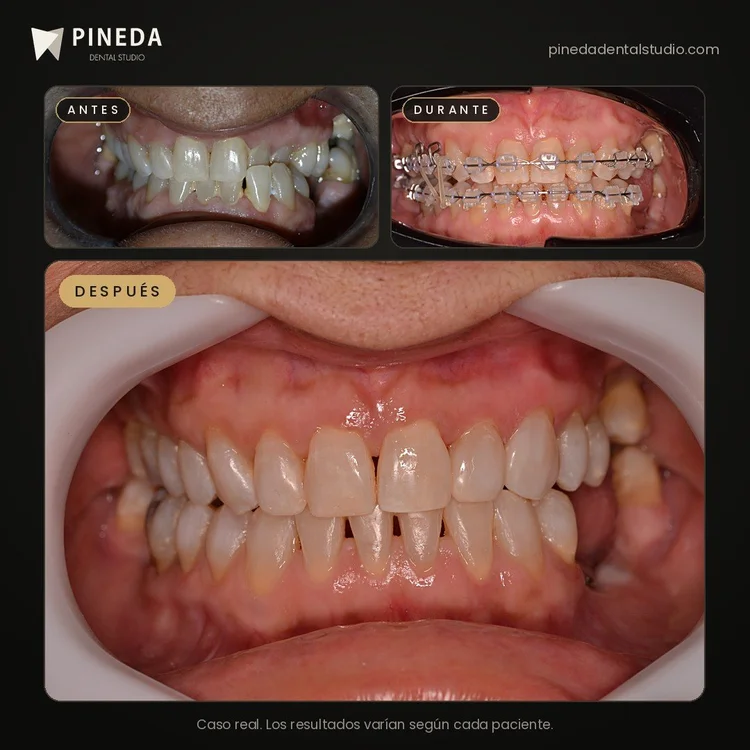
Before, during and after: clear sapphire braces, almost invisible, to correct crowding without the visual impact of metal.
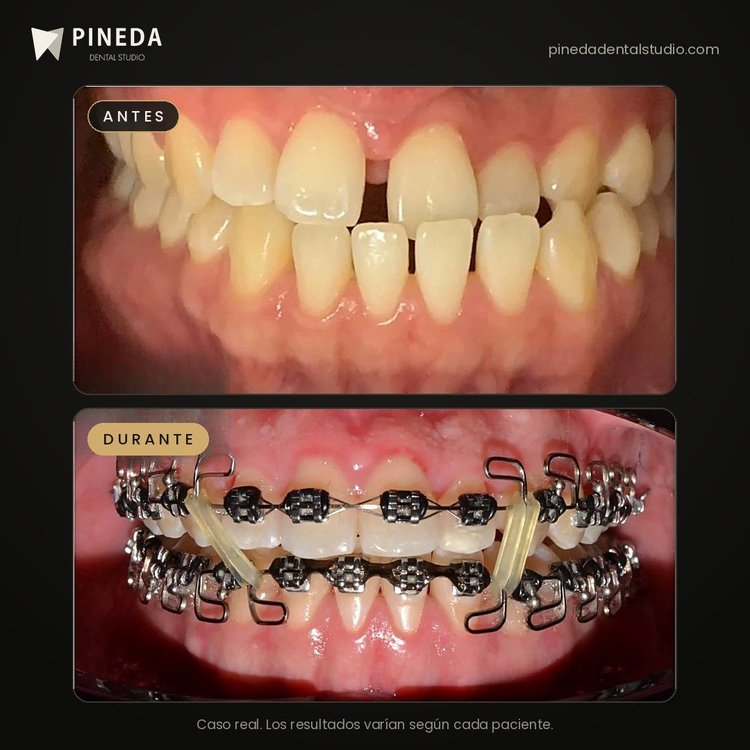
Before, with gaps between the front teeth; during, metal braces, the system with the most control for closing gaps and organizing the bite.
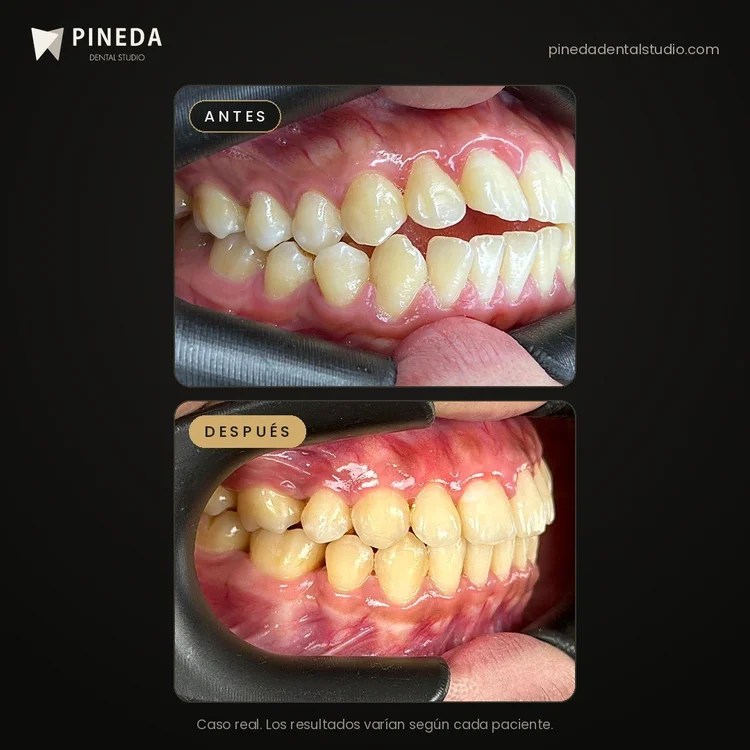
Before, the front teeth didn't touch; with orthodontics the bite now closes correctly.
As in all our treatments, the system is chosen after the diagnosis and digital scan, not before: what needs to move, how much and which tool is best for the job.
Real cases treated at our Recoleta clinic. Results vary from person to person.
How do we choose the system for each patient?
We don't start with the appliance. We start with the digital scan, X-rays and bite analysis, and only with all that on the table do we think about the tool. These are the criteria that matter:
- The complexity of the movements. Large rotations, roots to straighten, extractions and bite corrections tip the balance toward braces. Mild or moderate alignment and gap closing, toward aligners.
- Real discipline, not stated discipline. Aligners work with 22 hours of wear. If that's not going to happen, it's better to know beforehand and choose a fixed system.
- Hygiene and the state of the gums. A patient with inflamed gums or a history of gum disease needs a system that lets them clean well, and a plan of professional cleanings during treatment, whatever the appliance.
- Aesthetic demands. Dealing with the public, events, photos: it counts, a lot. But it's weighed after the diagnosis, not before.
- Age and growth. In teenagers who are still growing, some movements and corrections are better handled by a fixed system.
- What comes next. If orthodontics is a step before veneers, implants or a rehabilitation, the system has to serve that plan. We coordinate it with our cosmetic dentistry and smile design area.
And one rule we don't bend: if the case calls for braces and the patient wants aligners, we say so. We'd rather lose a treatment than deliver a half-finished result.
Why did we stop doing lingual orthodontics?
For a while we offered it. Lingual orthodontics bonds the brackets to the inner surface of the teeth, on the tongue side, and it's the only fixed technique that's truly invisible from the outside. It's a valid technique, with good results in the hands of colleagues who master it, and we didn't drop it for that reason. We dropped it because of what we saw in our own patients.
The first issue was the tongue. Lingual brackets rub against the tongue all day, and many patients spent weeks with sores and difficulty speaking clearly. The second was hygiene: the inner surface of the teeth is harder to see and brush, and with a bracket on it, much harder. Research matches what we observed: a systematic review with meta-analysis published in the American Journal of Orthodontics and Dentofacial Orthopedics found that patients with lingual appliances had a much higher likelihood of tongue pain and speech difficulties, and more trouble keeping up good hygiene, compared with appliances on the outer surface (Ata-Ali et al., 2016).
And the third was that something better came along for the same goal. Aligners offer the same discretion, with nothing rubbing against the tongue, with normal hygiene and with digital planning that lingual didn't have. For the patient who used to ask us for lingual, today the answer is almost always aligners, or cosmetic braces when the case calls for them.
We stopped doing it not because it doesn't work, but because it was no longer the best option we could offer for what people wanted from it.
Frequently asked questions
What's the best type of orthodontics?
There isn't a best one in the abstract. There's the one that fits your case, your age, your hygiene and your discipline. A good orthodontist recommends the system after the diagnosis, not before.
Are aligners faster than braces?
In mild and moderate cases, the evidence shows somewhat shorter treatments with aligners. In complex cases or those with extractions, we usually recommend braces because they give more control. The case sets the speed more than the appliance does.
Do self-ligating braces hurt less or finish sooner?
The evidence doesn't support it. Their real advantage is practical: shorter appointments and no ties to loosen or stain.
Do cosmetic braces stain?
Ceramic or sapphire brackets don't stain. What can stain are the elastic ties that hold the wire, and they're changed at every check-up. Cosmetic self-ligating braces avoid that problem.
How many hours a day do aligners need to be worn?
Twenty-two. They're only taken out to eat and brush. Wearing them less doesn't make treatment slower: it makes it fail.
Can you switch systems halfway through treatment?
Yes, and sometimes we plan it that way from the start: a phase with braces for the difficult movements and a finish with aligners for the details.
Do you do lingual orthodontics?
Not anymore. We offered it for a while and discontinued it because of tongue discomfort and speech problems, the difficulty with hygiene, and because aligners meet the same need for discretion better. It's a valid technique that other colleagues do well.
What about white spots after braces?
They appear when plaque builds up around the bracket. They're prevented with hygiene and professional cleanings during treatment, and if they remain, they're treated with resin infiltration without wearing down the tooth.
Diagnosis first, then the appliance
If you've read this far with a fixed idea of which system you want, that's fine: it's a starting point. What we suggest is turning it around for a moment. Come in, we'll do the scan, look at what needs to move and how much, and show you which system best solves your case and why. If it matches what you had in mind, great. If not, you'll know exactly what you gain and what you lose with each option.
Ayacucho 1230, Recoleta · We reply the same day
📍 We look forward to seeing you at our clinic in Recoleta, Buenos Aires.
👩🏻⚕️ About the author and clinical director
Od. Mariana Pineda (M.N. 39.080) is a dentist (José Antonio Páez University, 2014) and trained in fixed, removable and implant-supported prosthodontics at the Asociación Odontológica Argentina (2018). As clinical director of Pineda Dental Studio, she leads a multidisciplinary team of more than 10 dentists in orthodontics, oral rehabilitation, cosmetic dentistry, implants and maxillofacial surgery, following international protocols for minimally invasive dentistry.
Medical notice: the information in this article is for educational purposes. The choice of orthodontic system, the estimated length of treatment and whether to combine techniques depend on the individual clinical diagnosis we make at the clinic.
📚 Scientific sources consulted
- Chen, S. S.-H., Greenlee, G. M., Kim, J.-E., Smith, C. L., & Huang, G. J. (2010). Systematic review of self-ligating brackets. American Journal of Orthodontics and Dentofacial Orthopedics, 137(6), 726.e1–726.e18.
- Ke, Y., Zhu, Y., & Zhu, M. (2019). A comparison of treatment effectiveness between clear aligner and fixed appliance therapies. BMC Oral Health, 19, 24.
- Crego-Ruiz, M., & Jorba-García, A. (2023). Assessment of the periodontal health status and gingival recession during orthodontic treatment with clear aligners and fixed appliances: a systematic review and meta-analysis. Medicina Oral, Patología Oral y Cirugía Bucal. doi:10.4317/medoral.25760
- Ata-Ali, F., Ata-Ali, J., Ferrer-Molina, M., Cobo, T., De Carlos, F., & Cobo, J. (2016). Adverse effects of lingual and buccal orthodontic techniques: a systematic review and meta-analysis. American Journal of Orthodontics and Dentofacial Orthopedics, 149(6), 820–829.
