
By: Od. Mariana Pineda | Reading time: 4 minutes
For decades, the first step of any major dental treatment (a crown, an implant or orthodontics) was one of the moments patients dreaded most: taking impressions.
Putting up with a metal tray full of cold paste (alginate or silicone) that filled the palate and caused gagging or a choking feeling was an experience many people preferred to avoid at all costs.
At Pineda Dental Studio we believe clinical excellence has to go hand in hand with patient comfort. That's why we left the techniques of the past behind and adopted the technology that's transforming modern dentistry: the intraoral scanner and digital smile design (DSD).
What is an intraoral scanner and how does it work?
In most cases, you can forget about pastes and uncomfortable molds. The intraoral scanner is a high-precision device, about the size of an electric toothbrush or a thick pen, that we glide gently around the inside of your mouth.
As we do, the camera captures thousands of photos per second. These images are processed instantly on a computer to create an exact, full-color "3D digital clone" of your teeth and gums.
Some specific cases may still need traditional impressions. The scanner emits no radiation and takes just a couple of minutes: you can breathe and swallow completely normally while we scan your mouth.
At our clinic
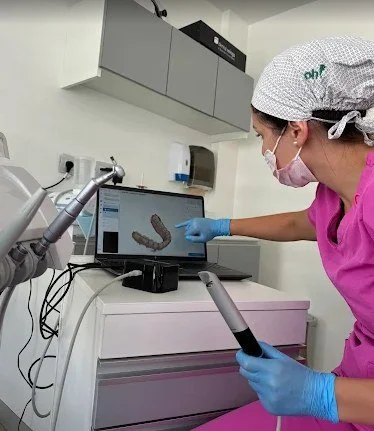
3D intraoral scan: the digital model of your teeth appears instantly on the screen.
Digital smile design (DSD): try your teeth before we touch them
Having a 3D model of your mouth on our screen opens up a world of possibilities, and the most fascinating is digital smile design (Digital Smile Design).
We use this digital design for ceramic veneers and crowns. Composite veneers are sculpted freehand, directly on your teeth, based on photo analysis.
In the past, patients had to trust blindly in how their ceramic veneers or crowns would turn out. Today, science lets us reverse that process:
Facial analysis: we take photos of your face while you talk and smile.
3D design: we overlay the scan of your teeth on your face. We digitally design the shape, size, color and proportions of your new teeth so they match your facial features, your lips and your personality.
The trial (mock-up): before touching a single millimeter of your enamel, we can 3D print that design and try it directly in your mouth with a temporary resin.
You'll be able to look in the mirror, see yourself smile and approve the final cosmetic result before any clinical treatment starts. That reduces uncertainty and makes the result much more predictable.
The benefits of digital dentistry at Pineda Dental Studio
This digital workflow, backed by scientific evidence, translates into direct advantages for you:1
Comfort: in most cases we eliminate impression pastes, gagging and stress in the dental chair.2
Micrometric precision: digital files don't suffer distortion, shrinkage or deformation like older materials. That's why your future inlays, crowns or clear aligners will fit precisely, with less risk of leakage.3
Speed and efficiency: since no plaster models need to be sent, your 3D file reaches our lab in seconds and treatment times are much shorter (see how long crowns and veneers take).
Predictability: you co-create your treatment. By seeing the final result in advance, we make decisions about the look of your smile together.
Technology in the service of empathy
Having the best technology in the world means nothing if it isn't used to improve the human experience. At Pineda Dental Studio, the intraoral scanner isn't just a precise diagnostic tool: it's our way of telling you that your comfort, your time and your peace of mind are our priority.
If you've been putting off cosmetic or restorative treatment because of memories of those old, unpleasant impression pastes, we invite you to experience the dentistry of the future.
Frequently asked questions
Does the intraoral scanner emit radiation?
No. It's an optical recording, with no radiation.
How long does the scan take?
A couple of minutes. You can breathe and swallow normally.
Is impression paste no longer used?
In most cases, no.
Can I see how it will look before we start?
Yes. With the mock-up you try the design in your mouth before the enamel is touched.
What is DSD?
It's digital smile design: we plan the result in 3D based on the scan.
📍 We look forward to seeing you at our clinic in Recoleta, Buenos Aires.
About the author and clinical director
Od. Mariana Pineda is a dentist (José Antonio Páez University, 2014) and trained in fixed, removable and implant-supported prosthodontics at the Argentine Dental Association (2018).
As founder and clinical director of Pineda Dental Studio in Recoleta, she leads a team of more than 10 dentists who share one philosophy: combining scientific excellence, advanced technology and unhurried personal care to transform the experience of going to the dentist.
Medical notice: the information in this article is strictly for educational and informational purposes. It never replaces a clinical diagnosis or professional dental treatment.
Scientific sources consulted
Coachman, C., et al. (2012). "Digital Smile Design: A Tool for Treatment Planning and Communication in Esthetic Dentistry." Quintessence of Dental Technology.
Yuzbasioglu, E., et al. (2014). "A comparison of patients' perceptions and preferences of traditional and digital impressions." BMC Oral Health, 14(10).
Joda, T., & Brägger, U. (2015). "Digital vs. conventional implant prosthetic workflows: a cost/time analysis." Clinical Oral Implants Research.
