
By: Od. Mariana Pineda | Reading time: 4 minutes
When you look in the mirror and open your mouth, you may well notice old dark grey or black metal fillings. For much of the 20th century, silver amalgam was the most widely used material in the world for treating cavities, because it was durable and cheap.
But modern dentistry has changed radically. Today, at Pineda Dental Studio, we see patients every day who want to replace these metal restorations. While most come looking for a cosmetic improvement, the clinical reality is that replacing an old amalgam goes far beyond having white teeth.
Below, we explain why metal fillings belong to the past and how adhesive dentistry can restore your teeth's structural health.
The hidden problem with amalgam fillings
Unlike the modern materials we use today, amalgams have three fundamental biomechanical drawbacks that, over the years, compromise the health of the tooth:
No bonding: Metal doesn't "stick" to the tooth. To keep an amalgam from falling out, dentists in the past had to drill away healthy tooth tissue and create a "box"-shaped cavity that held the metal in by mechanical pressure alone. This greatly weakens the tooth's original structure.
The "wedge" effect and microfractures: Metals expand with heat (when you drink coffee) and contract with cold (when you eat ice cream). This constant movement inside a rigid structure like enamel eventually causes cracks. Over time, the tooth acts as if it had a wedge inside it and can fracture catastrophically when chewing.
Marginal leakage: Over the years, the edges of the amalgam lose their seal. This creates a microscopic gap where bacteria and saliva get in, and silent decay forms underneath the metal filling, usually impossible to see with the naked eye because of the material's dark color.
The solution: adhesive dentistry and high-quality composites
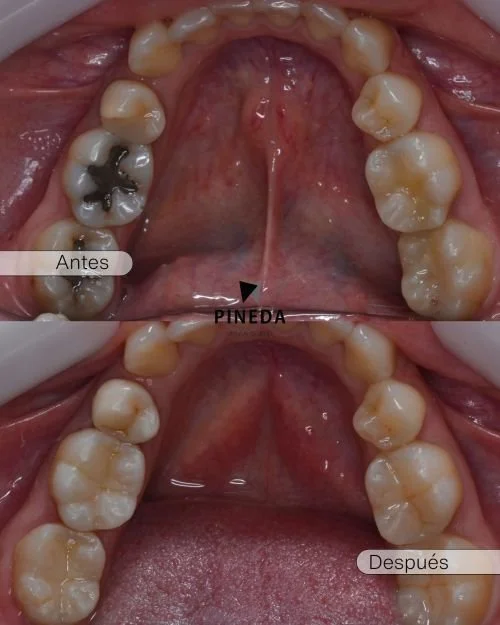
As you can see in our "before and after" clinical documentation, the approach at Pineda Dental Studio completely transforms the tooth's anatomy and health.
When we remove a leaking amalgam, our team applies minimally invasive dentistry protocols:
Rubber dam isolation: We use a special rubber sheet (dental dam) to isolate the tooth. This makes sure you don't swallow debris while the old metal is removed and that we work in a moisture-free field.
Cleaning and diagnosis: When we remove the metal, we often find darkened tissue or decay underneath. We clean the area thoroughly and preserve as much healthy tissue as possible.
Biomimetic restoration: Instead of pressing in metal, we use nanotechnology composite resins (for small or medium cavities) or ceramic inlays (for large cavities). These materials bond chemically to the tooth and merge with it.
If you'd like to learn more, we explain adhesive dentistry and inlays, which we provide in oral rehabilitation.
The benefits of updating your restorations
Replacing your amalgams with our clinical protocols gives you immediate and long-term advantages:
Restored strength: By bonding chemically, composites and inlays "hug" the walls of the tooth, give back up to 90% of its original structural strength and help prevent fractures.
Discreet appearance: We copy the anatomy, grooves and exact color of your enamel. Your tooth looks natural again and nobody will notice it was restored.
Biocompatibility: We use metal-free materials, which removes any risk of sensitivity from thermal conductivity or galvanism (that "electric shock" you sometimes feel when you bite a metal fork with an amalgam filling).
If you have dark fillings from years ago and want to make sure there's no hidden decay underneath, or you simply want to smile again without showing metal, now is the ideal time for an assessment.
Frequently asked questions
Why replace an amalgam filling?
Over time, marginal leakage can appear: the edge opens up and decay can get in underneath.
How is the tooth protected during the replacement?
We work with a rubber dam, which isolates the tooth.
Composite or inlay?
Composite for small or medium cavities. Inlay for large cavities.
How strong is the tooth afterwards?
With adhesive techniques, especially with an inlay, the tooth can recover up to 90% of its original strength.
Does the result contain metal?
No, it's metal-free.
How much does it cost?
It depends on how many teeth and whether they need composite or an inlay. We'll tell you after the assessment.
📍 We look forward to seeing you at our clinic in Recoleta, Buenos Aires.
About the author and clinical director
Od. Mariana Pineda is a dentist (José Antonio Páez University, 2014) and trained in fixed, removable and implant-supported prosthodontics at the Argentine Dental Association (2018). National license M.N. 39.080.
As founder and clinical director of Pineda Dental Studio in Recoleta, she leads a team of more than 10 dentists who share one philosophy: combining scientific excellence, minimally invasive dentistry and personal support to transform each patient's experience.
Medical notice: the information in this article is strictly for educational and informational purposes. It never replaces a clinical diagnosis. Every patient is unique and needs an individual in-person assessment.
Scientific sources consulted
Magne, P., & Belser, U. (2002). Bonded Porcelain Restorations in the Anterior Dentition: A Biomimetic Approach. Quintessence Publishing.
Belli, S., et al. (2014). "The effect of fiber placement on fracture resistance of endodontically treated teeth restored with inlay/onlay restorations." Journal of Adhesive Dentistry.
Opdam, N. J., et al. (2010). "Longevity of posterior composite restorations: a systematic review and meta-analysis." Journal of Dental Research.
