
By: Od. Mariana Pineda | Reading time: 4 minutes
In my work in fixed prosthodontics, one of the most common situations our team sees at the clinic is a patient who arrives with a badly damaged tooth, whether from deep decay, a fracture or replacing an old amalgam filling.
Historically, the traditional solution was drastic: grind the healthy tooth down almost to a small stump to fit a full "crown" or cap. Today, at Pineda Dental Studio, we're proud to say the science has moved on.
Thanks to minimally invasive adhesive dentistry and the biomimetic philosophy, our team has protocols to rebuild your tooth while keeping as much of its natural structure as possible. Here's how we do it.
Biomimetic dentistry: copying nature
Biomimetics is the science that studies nature's models in order to imitate its designs. In dentistry, it means our goal is no longer to press rigid materials into place, but to give the tooth back the flexibility, strength and appearance it originally had.
To achieve this, at our clinic we replace traditional crowns with partial adhesive restorations, known scientifically as inlays, onlays and overlays.
Unlike regular fillings that are shaped in the mouth, these are custom-made pieces of high-strength ceramic or composite produced in the lab (like a piece of a jigsaw puzzle), which we then bond chemically to your tooth.
Inlay: restores the center of the tooth without covering the cusps (the chewing edges).
Onlay: covers one or more damaged cusps and protects the tooth from fractures.
Overlay: covers the whole chewing surface. It's ideal for heavily worn teeth or teeth that have had a root canal, without having to file down the sides of the tooth as you would for a crown.
Before and after
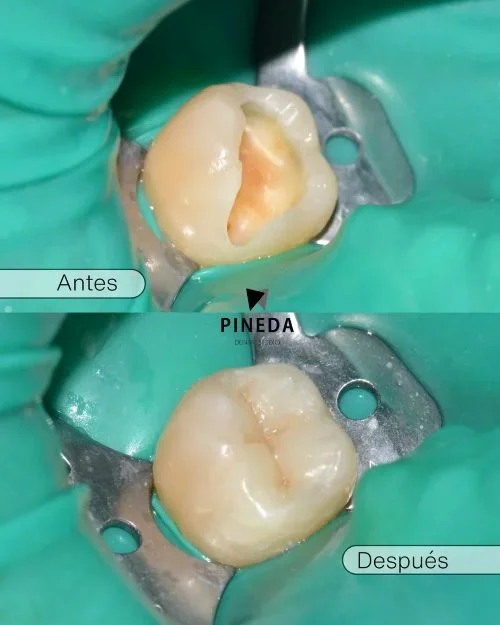
Composite inlay on a badly damaged molar, done with rubber dam isolation.
Results vary from patient to patient.
The structural secret: glass fiber reinforcement
When a tooth has lost a lot of structure (for example, after a root canal), it's weakened and prone to catastrophic fractures when chewing.
To prevent this, our team uses an advanced technique backed by rigorous scientific literature: glass fiber reinforcement. We place a microscopic mesh of fibers at the base of the restoration. That network works just like the steel bars inside reinforced concrete: it absorbs chewing stress and spreads the forces, keeping the tooth's root from cracking.1
What this approach means for you
When our clinical team plans your rehabilitation with adhesive dentistry, you get scientifically proven benefits:2
Maximum tooth preservation: we keep your healthy enamel and dentin. The natural tissue saved today is extra lifespan for the tooth in the long run.
Superior strength: thanks to latest-generation adhesives and glass fibers, the rebuilt tooth recovers up to 90% of its original structural strength.3
Discreet appearance: modern ceramic materials mimic the exact translucency of a natural tooth. Nobody will notice you have a restoration.
Healthier gums: since there's no need to push metal margins or thick crowns below the gum line, we avoid chronic inflammation and bleeding, very common problems with old-style caps.
We make inlays and crowns in oral rehabilitation and prosthetics, and fiber-reinforced restorations in general and restorative dentistry.
Complex rehabilitation, without rushing
At Pineda Dental Studio we believe saving a tooth is a work of biological engineering that takes precision, technology and judgment. We carry out every step of this process with the time and care your health deserves.
If you've been told you need a crown or you have a badly weakened tooth, we invite you to get a second opinion based on minimally invasive dentistry.
📍 We look forward to seeing you at our clinic in Recoleta, Buenos Aires.
About the author and clinical director
Od. Mariana Pineda is a dentist (José Antonio Páez University, 2014) and trained in fixed, removable and implant-supported prosthodontics at the Argentine Dental Association (2018).
As founder and clinical director of Pineda Dental Studio in Recoleta, she leads a team of more than 10 dentists who share one philosophy: combining scientific excellence, minimally invasive dentistry and personal support to transform each patient's experience.
Medical notice: the information in this article is strictly for educational and informational purposes. It never replaces a clinical diagnosis, treatment or medical advice.
Scientific sources consulted
To keep the highest standards, the protocols described in this article are based on the following research:
Belli, S., et al. (2014). "The effect of fiber placement on fracture resistance of endodontically treated teeth restored with inlay/onlay restorations." Journal of Adhesive Dentistry.
Magne, P., & Belser, U. (2002). Bonded Porcelain Restorations in the Anterior Dentition: A Biomimetic Approach. Quintessence Publishing.
Rocca, G. T., & Krejci, I. (2013). "Crown and post-free adhesive restorations for endodontically treated posterior teeth: from direct composite to endocrowns." European Journal of Esthetic Dentistry.
