
By: Od. Yesenia Sufuentes | Reading time: 4 minutes
Baby's first visit to the pediatric dentist: why should it be with the first tooth?
For decades there was a popular belief that children only needed to see the dentist once all their baby teeth were in or, unfortunately, when the first toothache appeared. Today, evidence-based dentistry has completely changed this approach and puts prevention first, from the very start of life.
At our clinic
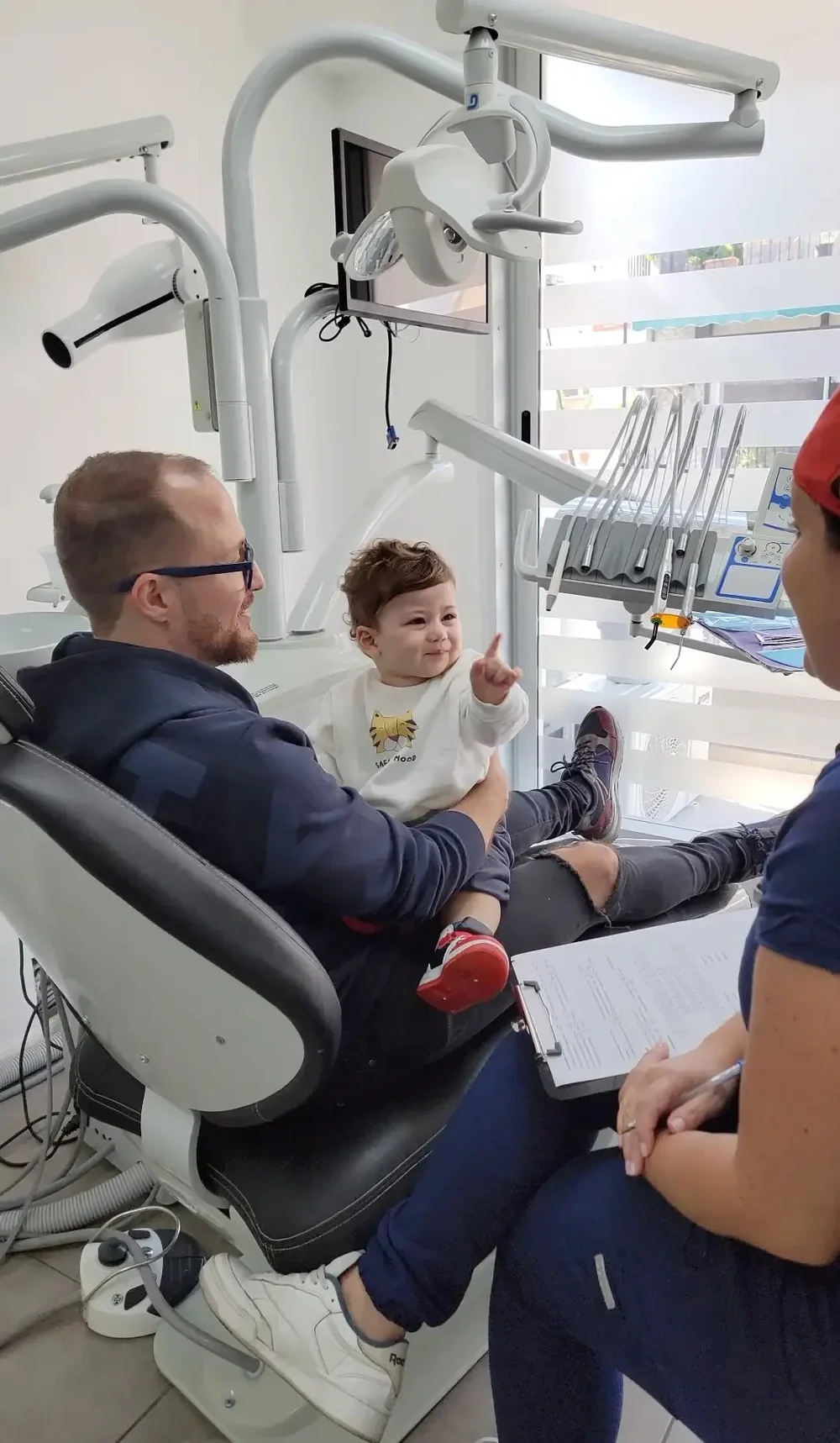
Od. Yesenia Sufuentes during a baby's first visit, with his dad.
The most respected international clinical guidelines agree: the first visit to the pediatric dentist should happen when the first tooth comes in or, at the latest, by the first birthday.
At Pineda Dental Studio, our philosophy moves away from reactive dentistry and embraces what science calls the "dental home".
What is a "dental home" and why does it matter for your child?
The dental home concept means building an ongoing, comprehensive and trusting relationship between the pediatric dentist, the patient and their family. Starting this relationship early lets us achieve a key goal: anticipatory guidance. It allows us to teach parents about the stages of jaw and facial growth, advise on breastfeeding and the move to solid food, and prevent early childhood caries (ECC) before it appears.
The science behind early prevention
Studies show that the bacteria responsible for tooth decay (such as Streptococcus mutans) can colonize the mouth much earlier than was thought. An early visit lets us:
Assess each child's individual risk of early childhood caries with standardized protocols.
Teach parents the right brushing technique and the right toothbrush for each age (it should be replaced every 3 months and always after an infectious illness).
Recommend the right use of topical fluoride at the exact doses (parts per million, or ppm) that current evidence considers safe and highly effective for protecting developing enamel.
Our approach: a positive experience with "tell, show, do"
We understand that a clinical setting can feel uncertain, both for little ones and their parents. To make this first contact a positive, stress-free experience, our pediatric dentistry team uses the tell-show-do behavior management technique.
This technique, the gold standard at leading children's clinics worldwide, respects the child's pace and removes the fear of the unknown:
Tell: we explain to the child (in language suited to their age) and to their parents exactly what we're going to do.
Show: we introduce the instruments and the surroundings in a playful way, and let the child see and touch harmless items, such as the dental mirror, before using them.
Do: once there's trust and anxiety has eased, we do the check-up quickly, gently and respectfully.
A commitment to the future of their smile
A healthy, functional adult smile starts in the first months of life. Acting early doesn't just prevent disease: it also guides the proper development of the jaws, speech and swallowing.
An accurate, early diagnosis is the first step toward your family's complete oral health. We invite you to book a visit with our pediatric dentistry team at Pineda Dental Studio, so we can support your child's development with the highest clinical and human standards.
Don't wait for pain to appear. Let's build your child's "dental home" together, so going to the dentist is always fun, safe and stress-free.
Frequently asked questions
When should I bring my baby for the first time?
With the first tooth, or before their first birthday.
What is the visit like?
We use the tell-show-do technique: we tell them, we show them and only then do we do it.
How should I brush their teeth?
With a small-headed, soft-bristled toothbrush, twice a day, the last time before bed. Until age 3, use fluoride toothpaste in an amount the size of a grain of rice.
How often should I change the toothbrush?
Every 3 months.
Is fluoride applied?
Yes, topical fluoride, as recommended by the pediatric dentist.
What to do if your child knocks a tooth →
📍 We look forward to seeing you at our clinic at Ayacucho 1230, Recoleta, Buenos Aires.
About the author
Od. Yesenia Sufuentes (M.N. 43.726) is a dentist (Santa María University, 2010) and trained in pediatric dentistry at the Central University of Venezuela (2017). She is a PBL lecturer in the Dentistry program at Maimónides University and is part of the Pineda Dental Studio team.
Medical notice: this article is strictly for educational and informational purposes and does not replace a professional dental consultation, diagnosis or treatment.
Scientific sources consulted
To ensure the quality and accuracy of the information, this article follows the guidelines of the world's most recognized dental institutions:
American Academy of Pediatric Dentistry (AAPD): policies on the dental home and preventive care.
International Association of Paediatric Dentistry (IAPD): global consensus on managing early childhood caries and the first dental visit.
National Library of Medicine (PubMed): systematic reviews on the effectiveness of anticipatory guidance and on reducing anxiety with behavior management techniques (tell-show-do).
