
By: Od. Mariana Pineda | Reading time: 4 minutes
If there's one thing we hear almost every day at our clinic in Recoleta, it's: "I'm terrified of the dentist". And we get it. Historically, gum treatments and minor surgery caused a lot of anxiety because of the scalpel, the stitches and the long recoveries.
As clinical director, my goal has always been for Pineda Dental Studio to offer scientific excellence without ever neglecting the human experience. That's why, together with my team, we decided to make the diode laser a standard part of our daily practice.
Today I want to explain, without incomprehensible medical jargon, why this minimally invasive dental technology makes such a difference to your comfort, and why our whole team relies on it.
The science behind the light: what is a diode laser?
A diode laser is a medical device that emits a highly concentrated beam of light, calibrated to act on soft tissues (such as the gums) and as a powerful antibacterial agent.
Unlike traditional instruments, which work by friction or mechanical cutting, the diode laser works on a principle of photothermal affinity. Put simply: the light acts selectively on inflamed tissue and bacteria, and preserves the healthy tissue around them. Thanks to that precision, our team uses it every day to reduce gum inflammation (periodontics), to sculpt the gum line in smile design and even to biostimulate and relieve mouth ulcers or jaw joint pain.
At our clinic
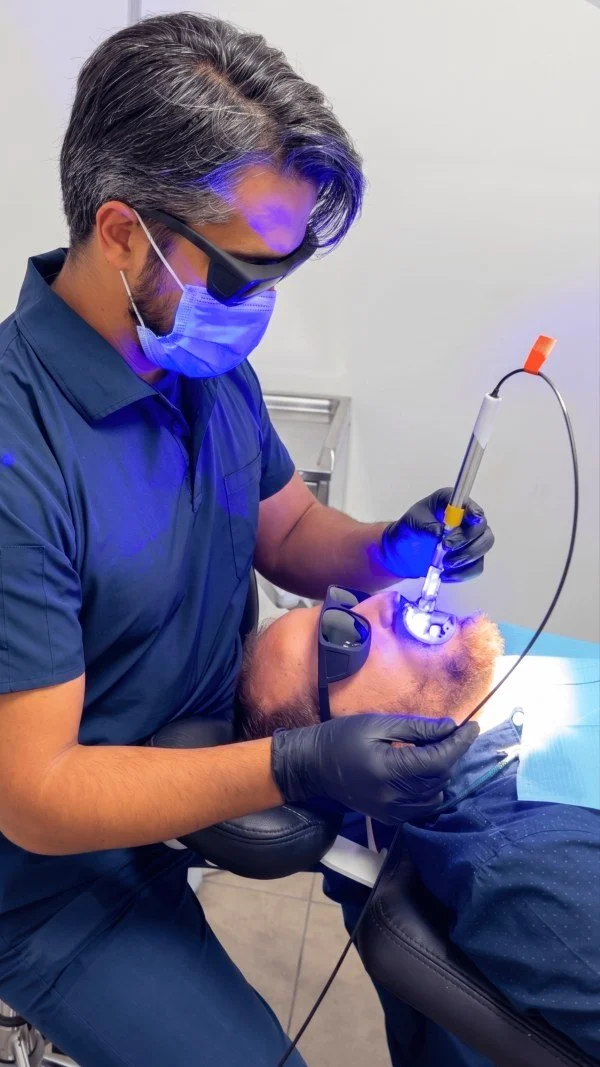
Diode laser treatment: less bleeding, less anesthesia and a faster recovery.
What we see in our daily clinical practice
When we tell a patient we're going to use the laser, the first reaction is usually surprise. But the results backed by science, which our team sees every day in the chair, are clear:1
Less bleeding and fewer stitches: the laser has excellent coagulation capacity. As it works on the gum, it seals blood vessels and nerve endings on the spot. In minor surgery this makes the procedure much cleaner and, in the vast majority of cases, no stitches are needed.2
Deep disinfection in root canal treatment: during root canal treatment, the light energy penetrates inside the roots and into microscopic areas that traditional disinfecting liquids don't reach as effectively. This lets us remove bacteria much more thoroughly and supports the long-term success of the treatment.3
Faster healing after surgery: after dental or gum surgery, "photobiomodulation" comes into play: the light energy stimulates the cells of the treated tissues. As a result, post-operative inflammation is greatly reduced and your body heals faster than with conventional methods.4
Less sensitivity with whitening: one of the biggest worries about whitening is sensitivity afterwards. By building the diode laser into our cosmetic protocols, we make the whitening gel work in less time and use the biostimulating effect of the light to desensitize the tooth. The result is whiter smiles with much less discomfort during and after the session.
Less anesthesia, more comfort: because it's a very gentle procedure with its own analgesic effect, our team can often reduce the amount of anesthesia needed considerably.
Our commitment to your smile
The most advanced technology in the world is worthless if the dentist doesn't take the time to keep training and to listen to the patient. At Pineda Dental Studio we share one philosophy: every treatment plan is tailored and built as a team. Our commitment is to offer you the best scientific evidence available, with the warmth and time you deserve, without rushing.
If you've been putting off dental care out of fear, we invite you to discover a different kind of dentistry.
Frequently asked questions
What are its advantages over a scalpel?
There's less bleeding, stitches often aren't needed and less anesthesia is required.
Does it help with mouth ulcers?
Yes, thanks to its analgesic effect. It relieves the discomfort within minutes and helps them heal sooner.
Is it used for TMJ pain?
Yes, as a complement to treatment, thanks to its analgesic effect. Together with a night guard, it helps reduce inflammation and muscle tension.
How much does it cost?
It depends on the procedure. We'll tell you after the assessment.
📍 We look forward to seeing you at our clinic in Recoleta, Buenos Aires.
About the author and clinical director
Od. Mariana Pineda is a dentist (José Antonio Páez University, 2014) and trained in fixed, removable and implant-supported prosthodontics at the Argentine Dental Association (2018).
As founder and clinical director of Pineda Dental Studio in Recoleta, she leads a team of more than 10 dentists who apply minimally invasive dentistry and laser technology in daily practice.
Medical notice: this article is strictly for educational and informational purposes and does not replace a professional dental consultation, diagnosis or treatment.
Scientific sources consulted
Convissar, R. A. (2015). Principles and Practice of Laser Dentistry. 2nd Edition. Mosby.
Romanos, G. E. (2015). "Diode Laser Applications in Periodontics." Journal of Laser Dentistry.
Kotsakis, A. S., et al. (2014). "A clinical and microbiological study of the use of diode laser as an adjunct to non-surgical periodontal therapy." Lasers in Medical Science, 29(6).
Domínguez, A., & Gómez, C. (2018). "Photobiomodulation in Dentistry: A review." International Journal of Dentistry.
