
You brush, you spit, and the foam comes out pink. You look at the toothbrush, figure you pressed too hard, and get on with your day. It doesn't hurt, so it doesn't feel urgent.
That's the problem. Inflamed gums bleed, but they almost never hurt, and what doesn't hurt gets put off. In Argentina, a survey in general dental practices across the country examined 3,694 adults: only 3.2 % had healthy gums, and just 16.4 % had gone to the dentist because of their gums (Romanelli et al., 2007).
In short
Healthy gums don't bleed, not with the toothbrush and not with floss. If they bleed, it is almost always gingivitis: inflammation caused by the bacterial plaque that builds up along the gumline. It is reversible: once the plaque and tartar are removed, the gums become healthy again, and the one thing you shouldn't do is stop brushing the area. Left untreated, it can progress to periodontitis, which destroys the bone that holds the tooth in place and can't be reversed: it can only be stopped and kept under control. Pregnancy, diabetes, some medications and low vitamin C make gums bleed more. Smoking does the opposite: it hides the bleeding and masks the disease. If your gums bleed on their own, or along with bruising, you should also see a doctor.
Why do my gums bleed when I brush?
Because they're inflamed, and almost always for the same reason: plaque left along the gumline.
Plaque is a soft film of bacteria that forms on the teeth every day. If it isn't removed, the gums react: more blood flows to the area, the tissue swells and becomes fragile, and it bleeds when something touches it, whether that's the toothbrush, floss or an apple. Over time, some of that plaque hardens into tartar, which a toothbrush can no longer remove and which traps even more plaque.
That is gingivitis, the most common form of gum disease (Murakami et al., 2018). And it isn't normal. The clinical definition is precise: the international consensus considers gums healthy when fewer than 10 % of the sites the dentist checks with a probe bleed. Above that, it's gingivitis (Chapple et al., 2018).
The American Academy of Periodontology describes gum disease as a silent condition: symptoms, especially pain, may not show up until it is advanced. That is why it's so easy to miss in your own mouth.
Should I stop brushing where it bleeds?
No. It's the most common reaction, and it makes things worse: if an area bleeds, you avoid it; if you avoid it, more plaque builds up; with more plaque, it bleeds more.
The proof is a 1965 experiment that is still used as a model in research. Volunteers with healthy gums stopped cleaning their teeth and developed gingivitis; when they went back to their hygiene routine, their gums became healthy again (Löe et al., 1965). In studies that repeat this model, inflammation appears between 9 and 21 days without oral hygiene (Jamjoom & Zahid, 2025).
The same thing shows up in reverse. In a trial with 119 adults with inflamed gums, two weeks of supervised brushing reduced bleeding sites by 35 %, and by about 67 % in the groups that also used dental floss (Graves et al., 1989).
In practice: brush the area that bleeds gently, and don't skip it. It may keep bleeding for the first few days; what matters is that it gradually eases. If it's the same after two weeks, there's something your toothbrush can't fix, and most often that's tartar.
What's the difference between gingivitis and periodontitis?
Gingivitis affects only the gums. Periodontitis affects what holds the tooth in place: the bone and the fibers that attach it to the root. The first one can be reversed. The second can't: lost bone doesn't grow back on its own, and the goal becomes stopping it.
Gums · Pineda Dental Studio
Healthy gums, gingivitis and periodontitis, side by side
What you notice, what happens underneath and what you can expect from treatment at each stage.
| Stage | What you notice | What happens underneath | Reversible? | What's done |
|---|---|---|---|---|
| Healthy gums The starting point. | Firm and attached to the tooth. No bleeding with the toothbrush or floss. | No inflammation. The bone is intact. | Nothing to reverse. | Daily hygiene and regular check-ups. |
| GingivitisReversible Gum inflammation. | Red or swollen gums that bleed when you brush or floss. It almost never hurts. | Only the gum is inflamed. The bone is still intact. | YesOnce plaque and tartar are removed. | Professional cleaning and a good hygiene routine at home. |
| Periodontitis Loss of tooth support. | All of the above, plus bad breath that won't go away, receding gums and teeth that move or drift apart. | The gum pulls away from the tooth and forms pockets. Bone is lost. | NoIt's stopped and kept under control. | Deep cleaning below the gumline under local anesthesia, re-evaluation and lifelong maintenance. |
You can't tell the two apart in the mirror. The difference is measured: with a probe that records the depth of the gum around each tooth, and with x-rays that show the bone. That's why the diagnosis is made at the dental office.
Sources are cited in the text and listed at the end.
Not all gingivitis progresses. But periodontitis doesn't develop on healthy gums: the same consensus describes gingivitis as its necessary first step (Chapple et al., 2018). The time to act is when your gums bleed, not when a tooth starts to move.
How much ongoing bleeding matters was measured in a 26-year follow-up of 565 Norwegian men with good hygiene habits. Teeth surrounded by gums that bled at every check-up had a 46 times higher risk of being lost than teeth with healthy or minimally inflamed gums. At 47 years after the tooth came in, 63.4 % of the first group were still in the mouth; at 51 years, 99.5 % of the second group were (Schätzle et al., 2004). And severe periodontitis isn't rare: the World Health Organization estimates more than one billion cases worldwide (WHO, 2025).
What else can cause bleeding gums?
Plaque is the cause. But some conditions make the same amount of plaque cause more inflammation, which explains why gums can start bleeding even if you haven't changed your hygiene. The international consensus calls them modifying factors (Chapple et al., 2018). Diabetes is one of them and has its own section below.
Pregnancy and hormonal changes. Hormones make the gums react more strongly. A review of 33 studies found that gum inflammation increases throughout pregnancy, especially in the second and third trimesters, without plaque increasing, and that it is lower after childbirth (Figuero et al., 2013). With today's low-dose birth control pills, this effect is no longer seen: it was seen with older formulas (Murakami et al., 2018).
Anticoagulants and antiplatelet drugs. Aspirin taken for the heart, clopidogrel, acenocoumarol or the newer anticoagulants don't cause gum disease. If the gums are already inflamed, they can make the bleeding more noticeable. The answer is not to stop them: the European consensus on periodontology and cardiology states that the evidence does not support stopping antiplatelet drugs before dental treatment, and that the dentist should not change that medication without consulting the treating doctor (Sanz et al., 2020a). What you should do is tell your dentist what you're taking.
Medications that enlarge the gums. Some anticonvulsants, like phenytoin; several blood pressure drugs from the calcium channel blocker family, like nifedipine or amlodipine; and cyclosporine, an immunosuppressant, can make the gums grow. It doesn't happen to everyone who takes them, and plaque has to be present as well as the drug (Murakami et al., 2018). Here too, nothing is stopped: hygiene is reinforced and the doctor is consulted.
Low vitamin C. Severe deficiency, scurvy, makes gums bleed because of a defect in collagen formation (Murakami et al., 2018). Even without reaching that extreme, low vitamin C is also linked to bleeding gums: an analysis of 15 clinical trials, with 1,140 participants, found that increasing intake in people with low levels helped reverse that tendency (Hujoel et al., 2021). This isn't a reason to take supplements just in case: it's a reason to look at how much fruit and vegetables you eat.
When you should also see a doctor. Gingivitis bleeding happens when something touches the gums. If they bleed on their own, if the bleeding is hard to stop, or if it comes with bruising for no reason, nosebleeds, marked tiredness or fever, the cause may not be in the mouth. In acute leukemias, for example, bleeding gums are the first oral sign in 17.7 % of cases, due to a lack of platelets and clotting factors (Murakami et al., 2018). It's uncommon. But when the bleeding doesn't match what's seen in the mouth, a medical visit and a blood test are in order.
Why do smokers' gums bleed less?
Because tobacco hides the symptom, not the disease.
An analysis of 12,385 people from the US national health and nutrition survey found that people who smoked more than 10 cigarettes a day had just over half the odds of their gums bleeding on examination compared with people who had never smoked (odds ratio of 0.56), and that the effect grew with the number of cigarettes (Dietrich et al., 2004).
The consequence is uncomfortable: in a smoker, gums that don't bleed tell you nothing. Smoking is, along with poor hygiene, one of the two main risk factors for periodontal disease (WHO, 2025), and at the same time it takes away the gums' way of warning you.
In former smokers, that effect was the smallest of all. If you've quit smoking and now notice bleeding, the inflammation may already have been there and simply become visible: it's a good time for a check-up.
What do gums have to do with diabetes and the heart?
This is one of the topics that gets exaggerated the most: it's worth separating what's proven from what's an association.
Diabetes: proven, and in both directions. Diabetes roughly triples the susceptibility to periodontitis, and there is a clear relationship between blood sugar levels and the severity of gum disease (Preshaw et al., 2012). The reverse is also measured: a Cochrane review of 35 clinical trials, with 3,249 participants, found that treating periodontitis lowers glycated hemoglobin (HbA1c) by 0.43 percentage points at three to four months, with moderate-certainty evidence, and rates it as a clinically significant improvement (Simpson et al., 2022). If you have diabetes, gum care is part of your treatment.
Heart: strong association, cause not proven. People with periodontitis have more coronary heart disease: the consensus of the European Federation of Periodontology and the World Heart Federation describes robust epidemiological evidence, and also an association with stroke (Sanz et al., 2020a). What hasn't been shown is that treating the gums prevents a heart attack: the Cochrane review on the topic found only two clinical trials, with very low-certainty evidence (Ye et al., 2022). Saying that a cleaning protects your heart goes beyond the evidence. What is established is that gum treatment is safe for people with cardiovascular disease, and that consensus recommends they have at least one dental check-up a year.
How do you treat gingivitis at home? What works and what doesn't
First, a limit: at home you control soft plaque. Tartar doesn't come off with any toothbrush, toothpaste or mouthwash: it's removed with dental instruments. That's why gingivitis usually needs both, a professional teeth cleaning, like the one we describe in our article on air polishing, and a daily routine to maintain it. Here's what the evidence says about that routine.
Electric or manual toothbrush. Electric toothbrushes have a small edge. In the Cochrane review of 56 studies, with 5,068 participants, they reduced gingivitis 6 % more than manual ones in the first three months and 11 % more after that, and the authors themselves note that the clinical importance of that difference is unclear (Yaacob et al., 2014). If you brush well with a manual toothbrush, there's no need to switch. If technique is hard for you, an electric one can be a good option.
Floss or interdental brushes. A toothbrush doesn't clean between the teeth. The Cochrane review on the subject, with 35 trials and 3,929 participants, found that adding floss to brushing may reduce gingivitis, and that interdental brushes may reduce gingivitis and plaque, perhaps more than floss, with low- or very low-certainty evidence (Worthington et al., 2019). For people who have already had periodontitis, the European periodontology guideline recommends interdental brushes and doesn't suggest floss as a first choice (Sanz et al., 2020b). The practical rule: where a small brush fits, use a small brush; where the teeth are very tight, use floss. The size is chosen at the dental office.
Mouthwashes. Chlorhexidine is the most studied and the most misused. It reduces plaque a lot, but in mild gingivitis the improvement in inflammation wasn't considered clinically relevant, and when used for four weeks or more it stains teeth, alters taste and increases tartar (James et al., 2017). It's a medication for short periods and with a prescription, not an everyday mouthwash. For daily use, the European guideline names two active ingredients, essential oils and cetylpyridinium chloride, as an add-on for specific cases (Sanz et al., 2020b).
"Gum care" toothpastes. It's better to look at the active ingredient than at the promise on the box. The same guideline mentions three: chlorhexidine, triclosan with copolymer, and stannous fluoride with sodium hexametaphosphate. A meta-analysis of six-month trials found that adding an antiseptic to brushing, in toothpaste or mouthwash, reduced bleeding about 15 percentage points more than brushing alone, with two caveats: the studies were very different from each other, and some authors declared receiving fees or funding from manufacturers (Figuero et al., 2020). They help, but on top of good cleaning, not instead of it: no toothpaste removes tartar or reaches below the gumline.
Home remedies, probiotics and supplements. For probiotics and antioxidant supplements, the guideline says it isn't known whether they help control gum inflammation (Sanz et al., 2020b). Salt water rinses, baking soda and coconut oil aren't among its recommendations: they don't remove plaque, which is what keeps the inflammation going.
How to tell if it's working. Less bleeding when you brush and clean between your teeth, within a couple of weeks. The confirmation comes at the check-up, where we measure how many sites bleed: the goal is fewer than 10 %.
How are gingivitis and periodontitis treated at the dental office?
Treatment follows a step-by-step sequence, the one we use in the gum treatment we provide in Recoleta, Buenos Aires:
- Measure before treating. At the first visit we do the exam, a deep teeth cleaning and any x-rays needed. With a periodontal probe we measure the depth of the gum around each tooth and record where it bleeds: that map, the periodontal chart, is what tells gingivitis apart from periodontitis.
- Remove the cause. For gingivitis, removing plaque and tartar and adjusting your hygiene technique is enough. For periodontitis, the root surface also has to be cleaned below the gumline, under local anesthesia.
- Measure again. A few weeks later, everything is re-evaluated. Sites that didn't respond may need another step, which is sometimes surgical.
- Maintain. Periodontitis is chronic: it's kept under control, not discharged. Check-ups are every 3 to 6 months, depending on the case; the European guideline allows up to 12 months, depending on each patient's risk (Sanz et al., 2020b).
About the laser. In our protocol we add the diode laser as a complement, to decontaminate the pockets after cleaning. What treats the disease is mechanical cleaning, the kind that removes plaque and tartar from the root. The European periodontology guideline doesn't suggest the laser as an add-on to that cleaning (Sanz et al., 2020b), and no laser replaces it. If someone offers to treat your gums "with laser only", ask how they're going to remove the tartar.
When the gums have already receded, treating the inflammation doesn't bring them back: that's what gum grafts are for. And healthy gums are the starting point for any other treatment: before teeth whitening or a dental implant, for example, the inflammation is treated first.
Real case · Pineda Dental Studio
Basic periodontal therapy: first stage
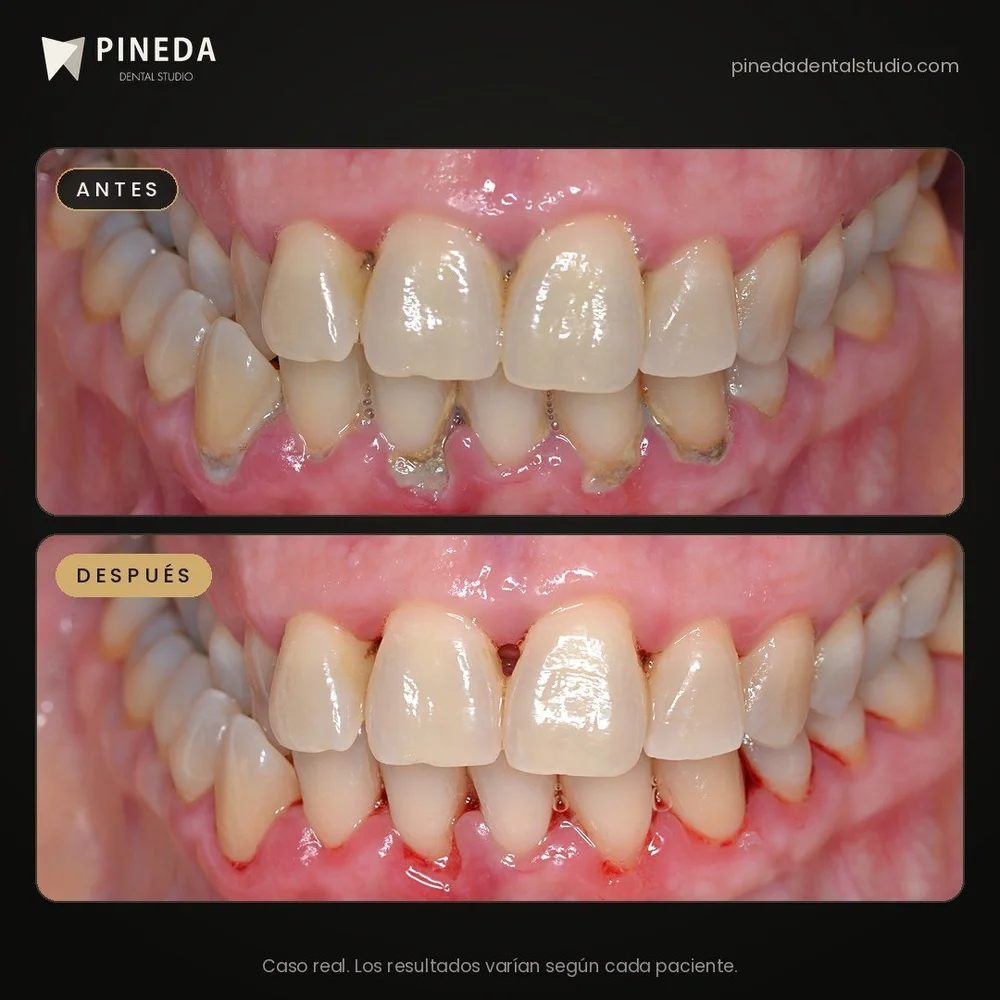
A periodontal patient with built-up tartar and inflamed gums. In the first stage of basic therapy we removed the tartar around the teeth, the first step to reduce gum inflammation. The after photo was taken at the end of the session: the slight bleeding you can see is normal.
Real case treated at our Recoleta clinic, with the patient's permission. Results vary from person to person.
When should you see a dentist, and when a doctor?
This guide doesn't replace a diagnosis, but it sorts out the most common situations:
- Your gums bleed when you brush or floss, and it keeps happening. Book a regular dental visit. It isn't an emergency, but it isn't something to ignore either.
- You improved your hygiene and it's the same after two weeks. There's something your toothbrush can't remove: you need a professional cleaning.
- You also have bad breath that won't go away, receding gums or loose teeth. These are signs of periodontitis. Don't put it off.
- You're pregnant, have diabetes or take anticoagulants. Get checked even if the bleeding is mild, and mention it when you book.
- You smoke and your gums don't bleed. That's not a sign of health. A check-up is still worth it.
- Very painful, swollen gums, or a sore, red patch or lump that doesn't go away. Get seen without delay: we offer emergency dental care.
- Your gums bleed on their own, the bleeding is hard to stop, or it comes with bruising, nosebleeds, fever or tiredness. See a doctor as well as a dentist.
Frequently asked questions
Is it normal for gums to bleed when flossing?
No. Healthy gums don't bleed with floss. If they bleed when you start flossing, it's because that area was already inflamed: the right thing to do is keep cleaning it gently every day. If it's still bleeding after two weeks, you need a check-up.
Can gingivitis be cured?
Yes. It's reversible: once plaque and tartar are removed and good hygiene is kept up, the gums become healthy again. What can't be reversed is periodontitis, the next stage: lost bone doesn't come back on its own, and treatment aims to stop it and keep it under control.
Is gingivitis treated with antibiotics?
That's not its treatment. Gingivitis is treated by removing plaque and tartar. Even for periodontitis, the European periodontology guideline doesn't recommend routine antibiotic use: they're kept for severe or specific cases, as decided by the dentist.
Is gingivitis contagious? Can you get it from kissing or sharing drinks?
Technically no: the disease is the gums' inflammatory reaction to the bacteria in plaque. But those bacteria can pass from one person to another through saliva, which is why the American Academy of Periodontology suggests not sharing utensils or hygiene items with someone who has periodontal disease. In Argentina, the same logic applies to sharing the mate straw.
Which vitamin deficiency causes bleeding gums?
Vitamin C. Severe deficiency, scurvy, makes gums bleed, and low levels are linked to more bleeding. Still, the most common cause is bacterial plaque. Before taking a supplement, it's best to have your gums checked by a dentist and your diet reviewed by a doctor.
Why do my gums bleed for no reason or while I sleep?
Very inflamed gums can bleed with the slightest touch, even at night. But bleeding that appears on its own isn't typical of gingivitis. If you also have bruising for no reason, nosebleeds, fever or a lot of tiredness, see a dentist and also a doctor.
Is it normal for gums to bleed during pregnancy?
It's common, but it isn't normal. Pregnancy hormones make the gums more inflamed in response to the same plaque, especially in the second and third trimesters. It's managed with good hygiene and professional cleaning, and there's no need to wait until after the birth to get checked.
Does mouthwash help bleeding gums?
As an add-on, not as a treatment. Chlorhexidine reduces plaque, but it's prescribed for short periods because after a few weeks it stains teeth and alters taste. No mouthwash removes tartar or replaces cleaning between your teeth.
No pain doesn't mean nothing is wrong
Bleeding is the most visible alarm your gums have, and it's a gentle one: it doesn't hurt, it doesn't get in the way, and it can be ignored for years. While it's going off, the problem can almost always be turned around. Once it's more than bleeding, it can't.
If your gums bleed and you want to know where you stand, at our dental clinic in Recoleta, Buenos Aires, we start by measuring: how much they bleed, where, and whether any bone is affected. That's what any dentist should offer you before recommending treatment. International patients get English support and translation help.
Ayacucho 1230, Recoleta · We reply the same day
📍 Visit us at our clinic in Recoleta, Buenos Aires.
👩🏻⚕️ About the author and clinical director
Od. Mariana Pineda (M.N. 39.080) is a dentist (Universidad José Antonio Páez, 2014) and trained in fixed, removable and implant-supported prosthodontics at the Asociación Odontológica Argentina (2018). As clinical director of Pineda Dental Studio, she leads a multidisciplinary team of more than 10 dentists in oral and maxillofacial surgery, implants, oral rehabilitation, cosmetic dentistry and endodontics, following international protocols for minimally invasive dentistry.
Medical disclaimer: the information in this article is for educational purposes and does not replace a dental visit. The diagnosis of gingivitis or periodontitis and its treatment depend on the individual clinical exam we do at the office. Do not stop or change any medication without instructions from the doctor who prescribed it.
📚 Scientific sources
- Chapple, I. L. C., Mealey, B. L., Van Dyke, T. E., et al. (2018). Periodontal health and gingival diseases and conditions on an intact and a reduced periodontium: consensus report of workgroup 1 of the 2017 World Workshop on the Classification of Periodontal and Peri-Implant Diseases and Conditions. Journal of Clinical Periodontology, 45(Suppl. 20), S68–S77. doi:10.1111/jcpe.12940
- Murakami, S., Mealey, B. L., Mariotti, A., & Chapple, I. L. C. (2018). Dental plaque-induced gingival conditions. Journal of Periodontology, 89(Suppl. 1), S17–S27. doi:10.1002/JPER.17-0095
- Romanelli, H., Gómez, M., Chiappe, V., González y Rivas, M., & Macchi, R. (2007). Periodontal treatment needs in Argentine adult subjects. Acta Odontológica Latinoamericana, 20(1), 39–47.
- Löe, H., Theilade, E., & Jensen, S. B. (1965). Experimental gingivitis in man. Journal of Periodontology, 36, 177–187.
- Jamjoom, A. G., & Zahid, T. M. (2025). Systematic review of experimental gingivitis induction methods: methodological variations and their impact on inflammation progression. Patient Preference and Adherence, 19, 3835–3848.
- Graves, R. C., Disney, J. A., & Stamm, J. W. (1989). Comparative effectiveness of flossing and brushing in reducing interproximal bleeding. Journal of Periodontology, 60(5), 243–247.
- Schätzle, M., Löe, H., Lang, N. P., Bürgin, W., Ånerud, Å., & Boysen, H. (2004). The clinical course of chronic periodontitis: IV. Gingival inflammation as a risk factor in tooth mortality. Journal of Clinical Periodontology, 31(12), 1122–1127. doi:10.1111/j.1600-051X.2004.00634.x
- World Health Organization (2025). Oral health. Fact sheet, 17 March 2025.
- Figuero, E., Carrillo-de-Albornoz, A., Martín, C., Tobías, A., & Herrera, D. (2013). Effect of pregnancy on gingival inflammation in systemically healthy women: a systematic review. Journal of Clinical Periodontology. doi:10.1111/jcpe.12053
- Sanz, M., Marco del Castillo, A., Jepsen, S., et al. (2020a). Periodontitis and cardiovascular diseases: consensus report. Journal of Clinical Periodontology, 47(3), 268–288. doi:10.1111/jcpe.13189
- Sanz, M., Herrera, D., Kebschull, M., Chapple, I., Jepsen, S., Berglundh, T., Sculean, A., & Tonetti, M. S. (2020b). Treatment of stage I–III periodontitis: the EFP S3 level clinical practice guideline. Journal of Clinical Periodontology, 47. doi:10.1111/jcpe.13290
- Hujoel, P. P., Kato, T., Hujoel, I. A., & Hujoel, M. L. A. (2021). Bleeding tendency and ascorbic acid requirements: systematic review and meta-analysis of clinical trials. Nutrition Reviews. PMID 33517432
- Dietrich, T., Bernimoulin, J.-P., & Glynn, R. J. (2004). The effect of cigarette smoking on gingival bleeding. Journal of Periodontology, 75(1), 16–22.
- Preshaw, P. M., Alba, A. L., Herrera, D., Jepsen, S., Konstantinidis, A., Makrilakis, K., & Taylor, R. (2012). Periodontitis and diabetes: a two-way relationship. Diabetologia, 55(1), 21–31. doi:10.1007/s00125-011-2342-y
- Simpson, T. C., Clarkson, J. E., Worthington, H. V., et al. (2022). Treatment of periodontitis for glycaemic control in people with diabetes mellitus. Cochrane Database of Systematic Reviews, 2022(4), CD004714.
- Ye, Z., Cao, Y., Miao, C., et al. (2022). Periodontal therapy for primary or secondary prevention of cardiovascular disease in people with periodontitis. Cochrane Database of Systematic Reviews, 2022(10), CD009197.
- Yaacob, M., Worthington, H. V., Deacon, S. A., Deery, C., Walmsley, A. D., Robinson, P. G., & Glenny, A.-M. (2014). Powered versus manual toothbrushing for oral health. Cochrane Database of Systematic Reviews, 2014(6), CD002281.
- Worthington, H. V., MacDonald, L., Poklepovic Pericic, T., Sambunjak, D., Johnson, T. M., Imai, P., & Clarkson, J. E. (2019). Home use of interdental cleaning devices, in addition to toothbrushing, for preventing and controlling periodontal diseases and dental caries. Cochrane Database of Systematic Reviews, 2019(4), CD012018.
- James, P., Worthington, H. V., Parnell, C., Harding, M., Lamont, T., Cheung, A., Whelton, H., & Riley, P. (2017). Chlorhexidine mouthrinse as an adjunctive treatment for gingival health. Cochrane Database of Systematic Reviews, 2017(3), CD008676.
- Figuero, E., Roldán, S., Serrano, J., Escribano, M., Martín, C., & Preshaw, P. M. (2020). Efficacy of adjunctive therapies in patients with gingival inflammation: a systematic review and meta-analysis. Journal of Clinical Periodontology, 47(Suppl. 22), 125–143. doi:10.1111/jcpe.13244
- American Academy of Periodontology. Frequently asked questions (perio.org, patient section).
- NHS. Gum disease (nhs.uk, page reviewed 20 April 2026).